
MDIM Journal of Management Review and Practice


Invictus Kynta1  and Durga Madhab Mahapatra1
1Department of Commerce, North Eastern Hill University, Shillong, Meghalaya, India

Creative Commons Non Commercial CC BY-NC: This article is distributed under the terms of the Creative Commons Attribution-NonCommercial 4.0 License (http://www.creativecommons.org/licenses/by-nc/4.0/) which permits non-Commercial use, reproduction and distribution of the work without further permission provided the original work is attributed.
This article presents a bibliometric analysis which examines the academic landscape surrounding consumer experience, perception, and loyalty toward e-commerce in rural regions. Utilising VOSviewer and Biblioshiny (R-based Bibliometrix package), the analysis maps were developed towards scholarly contributions or publication trends, co-authorship patterns, keyword co-occurrences, and thematic developments. An aggregate of 758 articles published between 2007 and 2025 (including articles or publications indexed in Scopus up to June 2025) was extracted from the Scopus database and analysed. The findings reveal a rapid rise in global e-commerce research, particularly after 2020, highlighting key themes such as trust, digital inclusion, and mobile commerce. However, the analysis also exposes a critical gap—while rural e-commerce is frequently referenced, much of the scholarship remains urban-centric, with limited engagement with rural-specific challenges, which includes; Digital divide (limited connectivity and digital literacy), trust deficits (frauds concerns and reliance on cash-on-delivery), cultural and linguistic barriers (vernacular access and traditional buying practices), and logistical constraints (last-mile delivery and infrastructure gaps). Therefore, underscoring the need for context-specific integration of socio-cultural, infrastructural and behavioural factors is required. This article also identifies influential authors, institutions, and future research directions, providing a robust foundation for further academic exploration, policy interventions and practical application aimed at promoting inclusive digital commerce ecosystems in underserved regions.
E-commerce, consumer experience, consumer loyalty, rural e-commerce, digital divide
Introduction
E-commerce refers to digitally enabled commercial transactions between organisations and individuals (Laudon & Traver, 2008) and has transformed the global retail landscape by offering convenience, wider product access and competitive pricing (Kumar & Dange, 2022). Traditionally, research and innovation in this field have been concentrated in urban areas (Singh & Srivastava, 2022), but recent studies increasingly examine e-commerce adoption and consumer behaviour in rural contexts. To map this evolution, the present study employs a bibliometric analysis of Scopus-indexed literature using VOSviewer and Biblioshiny (R-based Bibliometrix package), providing a roadmap of how research on rural e-commerce and consumer dynamics has developed over time.
Bibliometric analysis is a quantitative approach in reviewing scientific literature or research studies, whereby it enables a structured understanding of the publication trends, citation networks, keyword trends, authors’ relevance in the particular field of study, research clusters, and knowledge gaps (Donthu et al., 2021).
Customer Experience encompasses the entire online journey, including product discovery, interface usability, payment, delivery and after-sales interactions (Huang & Benyoucef, 2017).
Customer perception, closely linked to customer experience, reflects how users evaluate an online store based on elements which include: product quality, pricing, brand image and peer recommendations (Bhatti, 2020).
In an emerging e-commerce market, building customer loyalty goes beyond standard loyalty programmes. It depends on consistent service, hassle-free returns and personalised customer support (Srivastava & Dey, 2021). An e-commerce platform that cultivates loyal customers thrives in a competitive market and benefits from positive word-of-mouth that enhances brand value.
Review of Literature
This section delves into existing academic research and theoretical contributions pertinent to e-commerce platforms, focusing on customer experience, perception, and loyalty. Emphasis is placed on studies related to rural regions to provide a nuanced understanding of the aggregate contributions of scholarly research towards this domain.
E-commerce in rural regions is gaining scholarly attention, yet digital penetration remains uneven. These areas exhibit distinct socio-economic and infrastructural factors that shape consumer behaviour and adoption patterns (Paul, 2025). Choudhury (2021) notes constraints such as poor connectivity, low digital literacy, weak logistics and mistrust in online transactions. Nonetheless, growth opportunities are emerging with rising smartphone use and government initiatives promoting digital inclusion. The Diffusion of Innovation (DOI) framework (Rogers, 2003) helps explain these dynamics through attributes like relative advantage, compatibility and complexity that influence rural consumers’ adoption decisions.
In e-commerce, consumer experience includes interface usability, product information accuracy, delivery reliability and after-sales facility (Rose et al., 2012). This is consistent with the perceived ease of use (PEOU) of the technology acceptance model (TAM) and Unified Theory of Acceptance and Use of Technology (UTAUT) effort expectancy, both shaping usability perceptions. While urban-focused studies dominate, growing attention to rural digital inclusion highlights challenges such as limited infrastructure, low digital literacy and language barriers (Kumar et al., 2021). TAM provides a robust lens for understanding how perceptions of ease of use and usefulness (Davis, 1989) influence consumers’ overall experience and adoption.
Mishra (2023) emphasises the significance of developing e-commerce strategies to cater to the distinct preferences and constraints of rural consumers, that is, to develop a personalised e-commerce interface and service strategy to suit the local needs. This reflects UTAUT’s facilitating conditions, which underscore the importance of contextual infrastructure in enabling sustained user experience.
In rural settings, trust and perceived risk considerably influence purchase intentions (Bahl & Kesharwani, 2020). Anderson and Srinivasan (2003) state that loyalty depends on perceived value, prior experience and emotional engagement towards a particular platform but is often limited by logistics gaps, service inconsistency and lack of personalisation. Extensions of TAM that integrate trust and satisfaction (Gefen et al., 2003) and the Theory of Planned Behaviour (TPB) subjective norms show that loyalty grows through trust-building and community influence. Similarly, DOI’s concept of observability and UTAUT’s social influence emphasise the role of peer endorsement and visible benefits, which are critical for sustaining loyalty in rural e-commerce. Patel and Verma (2021) stress that tailored loyalty programmes and localised content are key to sustaining rural customer engagement.
Theories Related to the Study
Understanding consumer experience, perception, and loyalty in e-commerce cannot be achieved in isolation from the well-established theoretical frameworks that have guided technology adoption and digital behaviour research for decades. The following theories not only explain how consumers perceive and engage with digital platforms but also highlight the mechanisms that underpin loyalty and sustained usage, particularly in contexts such as rural regions where adoption dynamics differ from urban counterparts.
TAM—Davis (1989)
The TAM, proposed by Davis (1989), explains technology adoption through two key factors: Perceived usefulness (PU) and PEOU. In e-commerce, PU relates to how consumers view the benefits of online shopping, while PEOU reflects the ease of navigating platforms. Later extensions of the theory include trust and satisfaction (Gefen et al., 2003), which are vital for building loyalty. For rural consumers, trust and PU are especially critical due to limited literacy, infrastructural barriers and heightened risk concerns. Anchoring customer perception and experience in TAM helps explain why certain platforms succeed in generating repeat purchases and loyalty in underserved regions.
UTAUT—Venkatesh et al. (2003)
The UTAUT proposed by Venkatesh et al. (2003) integrates earlier adoption models and highlights four main constructs: perceived expectancy (perceived value), effort expectancy (ease of use), social influence (peer or community encouragement) and facilitating conditions (infrastructure support). These factors map directly into e-commerce perceptions of value, usability, trust and reliability. In rural contexts, facilitating conditions and social influence are particularly critical, as adoption often depends on peer recommendations and infrastructural availability. UTAUT also accounts for moderating factors such as age, gender and experience, making it useful for explaining both adoption and sustained loyalty in a diverse rural population.
DOI Theory—Rogers (2003)
According to Rogers (2003), the DOI theory describes how inventions proliferate through the phases of knowledge, persuasion, decision-making, execution, and confirmation, influenced by five attributes: Relative advantage, compatibility, complexity, trialability and observability. In rural e-commerce, these factors are crucial—Perceived advantage and compatibility influence adoption, complexity reflects usability challenges such as digital literacy or language barriers and trialability and observability build trust and loyalty through demonstrations and peer experiences.
TPB—Ajzen (1991)
The TPB (Ajzen, 1991) posits that behavioural intention is shaped by attitude (positive or negative evaluation of the behaviour), subjective norms (social pressures or expectations) and perceived behavioural control (ease or difficulty of performing the behaviour). In rural e-commerce, these dimensions are especially relevant—whereby attitudes reflect trust and perceived benefits, subjective norms capture the influence of the community and peer recommendations, and perceived behavioural control relates to digital literacy and infrastructural access. Together, TPB helps explain not only adoption but also the likelihood of consistent engagement with e-commerce platforms in rural regions.
Research Objectives
This research study is conducted with the main purpose of showcasing the recent trends and development in scholarly contributions towards the field of e-commerce and consumer dynamics in rural regions, and to analyse annual production, citation networks, etc., by incorporating a bibliometric analysis, which will help to better understand the patterns in research trends in this domain. Objectives pertaining to this research study are listed as under:
Research Methodology
Data Collection
Analysis Tools
VOSviewer and Biblioshiny were used to map co-authorship, citation, keyword co-occurrence, descriptive analysis, trend plotting, and thematic mapping (Van Eck & Waltman, 2010).
Research Trends in E-commerce Literature (2007–2025): Bibliometric Analysis (Results and Findings)
Annual Publication Growth
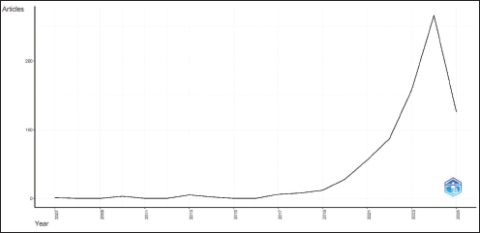
Based on Figure 1 and Table 1 which is generated from a bibliometric dataset acquired from Scopus database regarding the annual publication on the topic of e-commerce publications between the year of 2007 and 2025 it has shown a minor contribution in publication to the field starting with 2007–2014 and then an increase in momentum of publications between 2017 and 2025, with noticeable peaks in 2020–2024 which might be a contradictory approach in shopping behaviour or a leveraging effect of digital shopping platform due to a catalyst factor that is the COVID-19 pandemic which influence customers to shift from traditional shopping centres to shopping from digital platforms, which altogether brought about a digital transformation globally, accelerating interest in consumer behaviour online. Moreover, this momentum is optimised in the year 2024, and by the year 2025, there is a notable contribution to the field of study regarding e-commerce, and the aggregate publications and research were at their peak, with articles focusing on the personalisation of online experiences and social influences in e-commerce.
Figure 1. Annual Scientific Production.
Source: Scopus database.
Table 1. Annual Scientific Production.

Source: Scopus database.
Note: The 2025 data are incomplete and reflects records available in Scopus up to June 2025.
But unlike urban markets, which quickly shifted to digital platforms, rural regions faced compounded barriers such as unreliable last-mile delivery, limited availability of courier services, and a persistent digital illiteracy (Choudhury, 2021). This altogether restricted their ability to participate in e-commerce, even as urban adoption surged. This structural gap helps explain why, despite the sharp growth in overall publication counts, rural-focused research lags behind—scholars and researchers concentrated on broader digital adoption patterns while the unique constraints of rural consumers remained underexplored. Despite the growth towards this domain, there exists a partial integration of rural challenges in mainstream e-commerce discourse, which underscores the need for more targeted scholarship that directly examines how infrastructural and literacy-related barriers shape rural adoption trajectories.
Key Journals and Sources
Most Relevant Sources/Journals
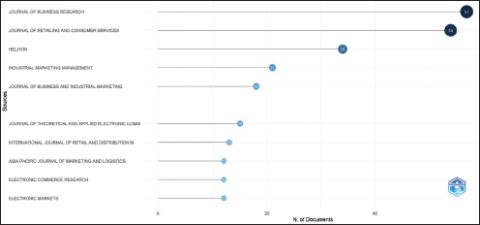
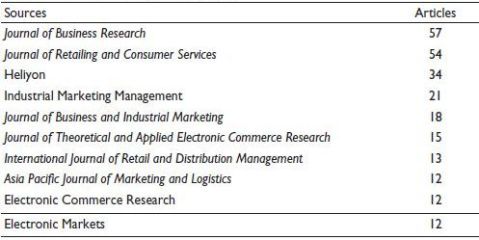
The Top 10 most prominent publication venues or sources, as shown in Figure 2 and Table 2, include:
Figure 2 and Table 2, generated using Biblioshiny (R-studio package), illustrates the Top 10 journals publishing e-commerce research from 2007 to 2025. The leading sources—Journal of Business Research (57 papers) and Journal of Retailing and Consumer Services (54 papers)—reflect the field’s multidisciplinary nature, bridging business strategy, consumer psychology and digital transformation. The former journal explores digital analytics and personalisation in shaping customer experience (Ren et al., 2020), while the latter journal focuses on functional and psychological drivers of online consumer behaviour (Gulfraz et al., 2022). Heliyon, with 34 papers, is a new multidisciplinary resource that addresses e-commerce service quality and loyalty (Rita et al., 2019). Other journals like Industrial Marketing Management, Journal of Business and Industrial Marketing and Asia Pacific Journal of Marketing and Logistics (21, 18 and 12 papers respectively), emphasise supply chain, B2B and logistics dimensions. Conceptual and technology-focused journals such as Journal of Theoretical and Applied Electronic Commerce Research, Electronic Commerce Research and Electronic Markets (15, 12 and 12 papers respectively) highlight theoretical developments, while the International Journal of Retail and Distribution Management (13 papers) centres on retail systems and channel management.
Figure 2. Top 10 Most Prominent Sources.
Source: Scopus database.
Table 2. Top 10 Most Prominent Sources.
Source: Scopus database.
Several journals, notably the Journal of Business and the Journal of Retailing and Consumer Services, dominate e-commerce publications. However, publication frequency reflects journal capacity and editorial scope rather than exclusive topical focus. For instance, the Journal of Business Research publishes over 500 articles annually (Scilit, 2025), often through special issues on digitalisation and consumer behaviour, boosting its bibliometric visibility. Likewise, Heliyon and Industrial Marketing Management appear prominent due to their interdisciplinary scope and openness to e-commerce studies. In contrast, rural development journals produce fewer articles, limiting their representation despite thematic relevance. This structural bias shows that mainstream marketing journals amplify urban-focused research, while rural-centric studies—addressing digital literacy, logistics and vernacular adaptation remain underrepresented. This imbalance also reveals or highlights a structural publication gap, whereby high output, mainstream journals amplify research on urban and global e-commerce trends, while rural-focused studies remain scattered across less prominent outlets. As a result, rural e-commerce challenges such as digital literacy, localised logistics and vernacular adaptation are often underrepresented in the literature, despite their central importance to inclusive digital commerce.
Sources Production Over Time
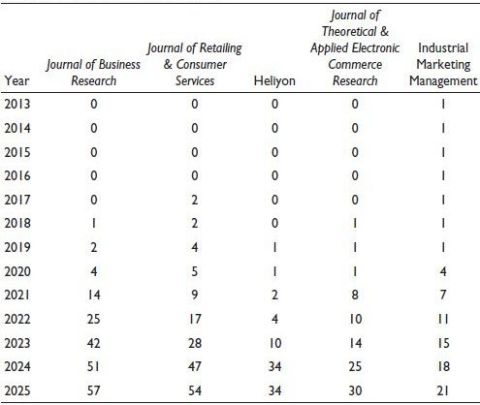
Figure 3, generated using Biblioshiny (R-package), illustrates the Sources Production Over Time for the Top 5 e-commerce journals (2007–2025). Whereby, publication years are displayed on the horizontal axis, and cumulative document numbers are displayed on the vertical axis. Each coloured line denotes a journal’s cumulative output—Heliyon (Red), Industrial Marketing Management (Olive), Journal of Business Research (Green), Journal of Retailing and Consumer Services (Blue) and Journal of Theoretical and Applied Electronic Commerce Research (Magenta).
Figure 3 and Table 3 show that the Journal of Business Research (Green) and Journal of Retailing and Consumer Services (Blue) experienced sharp growth after 2020, reflecting their prominence in publishing e-commerce, customer dynamics and digital marketing research. Heliyon (Red) emerged more recently as a key interdisciplinary and open-access outlet, with a notable surge between 2023 and 2024 after minimal earlier contributions. Meanwhile, Journal of Theoretical and Applied Electronic Commerce Research (Magenta) and Industrial Marketing Management (Olive) demonstrate steady but moderate growth, maintaining consistent contributions within theoretical and industrial e-commerce domains.
Figure 3. Sources Dynamics.Source: Scopus database.
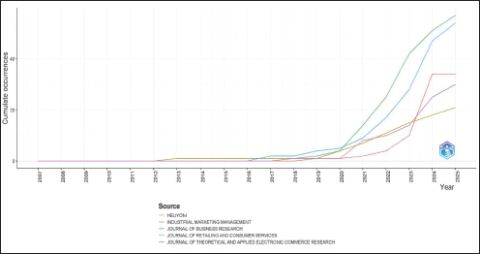
Table 3. Sources Dynamics Over Time.
Source: Scopus database.
Note: The 2025 data are incomplete and reflect records available in Scopus up to June 2025.
Most sources show limited publications before 2017, indicating that scholarly focus on e-commerce and customer dynamics accelerated sharply over the past decade, mirroring global adoption trends. A clear inflexion point appears in 2023–2024, with spikes in journals such as Journal of Business Research, Heliyon and Journal of Retailing and Consumer Services, reflecting post-pandemic digital transformation and the rise of data-driven consumer research.
Geographical and Author Collaboration Patterns
Leading Countries in the Field of E-commerce in Rural Contexts (Most Cited Countries)
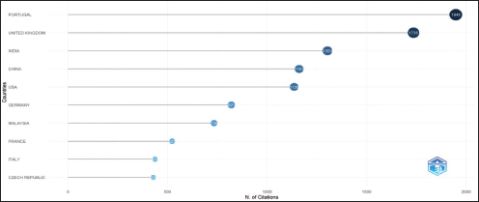
Figure 4, generated through Biblioshiny (R-package software), shows the number of citations attributed to research from different countries. Whereby, the number of citations is marked along the x-axis while the list of countries is listed against the y-axis, and each bubble size and colour represents the relative magnitude of citations, that is, larger and darker bubbles represent higher citation counts.
Figure 4 shows that Portugal leads in e-commerce research influence with 1,948 citations, followed by the United Kingdom (1.735), India (1,303), China (1,161) and the USA (1,136). Other contributors include Germany, Malaysia, France, Italy and the Czech Republic, with citation counts ranging from 821, 734, 525, 437 and 238, respectively. The mix of Western and Eastern nations highlights the global breadth of scholarly engagement, with Portugal and the UK emerging as particularly influential due to strong institutional and author contributions.
Despite large research outputs, countries with large market sizes like India and China often show lower citation impact. As seen in Figure 6, many publications originate from Indian and Chinese authors, yet citation counts—1,303 and 1,161, respectively—lag behind Portugal’s 1,948, indicating that influence matters more than volume. Smaller nations such as the Czech Republic and Malaysia also perform well relative to their size, reflecting stronger citation efficiency. In contrast, the United Kingdom maintains both high output and high impact, benefitting from robust research networks and global collaborations. This pattern suggests that strategic publishing in high-impact journals can yield greater scholarly influence, regardless of national output levels.
Figure 4. Most Cited Countries.
Source: Scopus database.
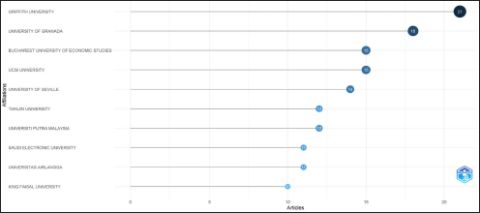
Figure 5. Most Relevant Affiliations.
Source: Scopus database.
Most Prolific Institutions
Figure 5, generated using Biblioshiny (R-package), illustrates the top academic and institutional affiliations contributing to this research domain. The x-axis represents the number of publications, while the y-axis lists institutions. Bubble size and colour denote publication volume—whereby, the larger and darker the bubble, the higher the number of publications.
Figure 5 shows that Griffith University leads with 21 publications, followed by the University of Granada (18 publications), both indicating strong institutional engagement and possible dedicated research groups. The Bucharest University of Economic Studies ranks next with 15 papers, focusing largely on business and digital economy topics. Other notable contributors include UCSI University (15), University of Seville (14) and Tianjin University (12). Additionally, Universiti Putra Malaysia, Saudi Electronic University, Universitas Airlangga and King Faisal University each contribute between 10 and 12 papers, reflecting participation in e-commerce scholarship.
This analysis highlights the global participation in e-commerce research, with contributions from Europe (Spain, Romania, United Kingdom), Asia (India, China, Malaysia, Indonesia, Saudi Arabia) and Australia. Malaysia and Saudi Arabia show strong representation, with multiple institutions—UCSI, Universiti Putra Malaysia, Saudi Electronic University and King Faisal University—appearing in the list. Their prominence reflects national investments in digital transformation research aligned with initiatives like Malaysia’s Digital Economy Blueprint and Saudi Arabia’s Vision 2030. Institutions with 10–12 publications also serve as emerging hubs and strategic collaborations in this domain.
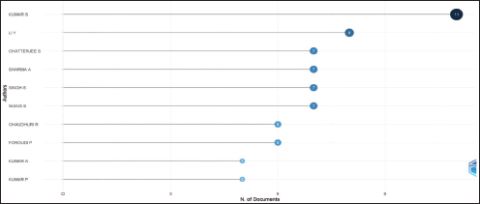
Figure 6. Top 10 Authors.
Source: Scopus database.
Griffith University and the University of Granada, with 21 and 18 publications respectively, dominate institutional affiliations, reflecting established research hubs supported by strong collaborations and investment in digital commerce studies. In contrast, emerging contributors such as UCSI University and Saudi Electronic University highlight growing research activity in developing regions, driven by digital inclusion and e-commerce adoption. This pattern reveals a dual trend—mature Western institutions sustain long-term output, while Asian and Middle Eastern universities are rapidly expanding their presence in line with regional policy priorities.
Although some institutions publish prolifically, their global impact varies. For example, Bucharest University of Economic Studies produced 15 articles, yet its citation influence is modest compared to Griffith or Granada. This suggests that international collaborations and placement in high-impact journals drive visibility, with Western institutions generally achieving greater global reach, while many Asian and Middle Eastern universities are still expanding their international presence.
Most Prolific Authors
Figure 6 shows the Top 10 authors in e-commerce research. The number of publications is presented on the x-axis, and the y-axis lists the authors, and bubble size and colour indicate publication volume, with larger and darker bubbles representing more output. Figure 6 clearly indicates; Kumar S., with 11 publications as the most prolific author and contributor, as well as a central figure in this field. Followed by Li Y. with eight publications, then Chatterjee S., Sharma A., Singh S. and Wang S., each with seven publications, towards this field. While Chaudhuri R. and Foroudi P. contributed a total of six articles, as well as Kumar A. and Kumar P., with five articles each, have contributed towards this research area.
The analysis highlights significant contributions from Indian authors, such as Kumar S., Chatterjee S., Sharma A., Singh S., Chaudhuri R., Kumar A. and Kumar P., reflecting India’s e-commerce growth and policy-driven digital inclusion (e.g., India’s Digital India initiative, 2015). However, Figure 4 shows higher citation influence for authors from countries like Portugal, indicating that locally focused publications may limit global impact. Authors like Foroudi P. and Paul J. demonstrate that fewer high-impact publications can achieve greater visibility, revealing two models of scholarly dominance: quantity with regional focus versus influence with global relevance.
Figure 7. Co-authorship Network.
Source: Scopus database.
Collaboration Networks (Co-authorship)
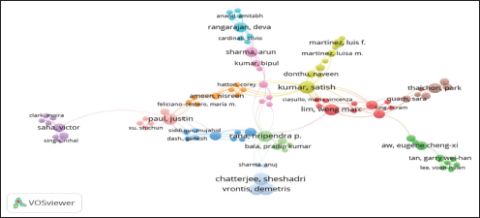
Figure 7 shows a co-authorship network in e-commerce research by means of VOSviewer. Whereby, each node represents an author, with size reflecting publication count or network centrality. Links indicate co-authorship, with thicker lines showing stronger collaboration, while colours represent clusters of frequently collaborating authors.
Analysis of Figure 7 shows Kumar S. as the most central and influential author, bridging multiple research clusters and indicating strong interdisciplinary and international collaboration. Other central authors which including Rana Nripendra P., Lim Wenng Marc and Paul Justin, also demonstrate multiple co-authorships, marking them as key influencers in e-commerce, digital marketing and consumer behaviour research.
The following clusters or research groups are derived from Figure 7 and are listed as under:
Through Figure 7, a regional collaboration pattern can also be determined in which can be classified into:
These authors demonstrate tight-knit collaboration clusters, often co-publishing within institutional silos rather than international networks.
The co-authorship network (Figure 7) further illustrates why certain authors and regions dominate scholarly visibility. Whereby, scholars such as Kumar S (Satish Kumar) act as a ‘bridge’ across clusters, linking otherwise fragmented research communities and ensuring cross-pollination of ideas. Such a bridging role explains their centrality and prominence in bibliometric maps. In contrast, many European and Latin American scholars remain siloed within regional collaboration clusters, which limit the international diffusion of their work despite high-quality outputs. Asian scholars, particularly from India, Malaysia, and China, show dense intra-regional collaboration, which explains high output but also creates an echo chamber that reduces global reach unless linked with Western networks.
Citation Networks
Garfield (1979) refers to citation analysis as a systemic study that illustrates the conceptual framework and development of a field of study throughout time, in which influential works, authors and journals are identified based on how they are frequently cited. Moreover, Garfield emphasised that citation indexing is not just a metric, but it is a tool to discover how ideas are propagated and how scientific knowledge is built upon prior work in any research domain.
Figure 8. Citation Network.
Source: Scopus database.
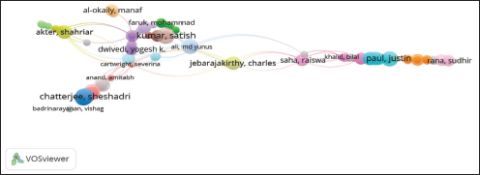
Figure 8 shows a citation network generated with VOSviewer, illustrating how often authors are cited together and their thematic connections. Each node size reflects citation frequency, with Paul J., Kumar S., and Chatterjee S. being highly cited. Also, each colours indicate clusters of authors sharing research domains or theoretical frameworks.
Figure 8 highlights Paul J., Kumar S., and Chatterjee S. as central figures in the citation network, whose work forms a foundational and widely referenced base in e-commerce, consumer behaviour and digital transformation. In contrast, authors like Sharma A. or Singh S., despite comparable or higher publication counts, appear less influential, underscoring that productivity alone does not equate to citation impact. The analysis reveals two distinct pathways to scholarly dominance: one through prolific output, as seen with Kumar S., and another through fewer but methodologically rigorous and theoretically rich contributions, exemplified by Paul J. and Foroudi P. The latter often fosters stronger cross-disciplinary citation linkages.
The citation network reveals regional contrasts: Indian-origin scholars like Kumar S., Chatterjee S., and Rana S. show a strong presence, but their influence is concentrated within technology adoption and consumer behaviour models. In contrast, European and Portuguese scholars are more thematically dispersed and interconnected, contributing to higher citation impact despite lower output—particularly in Portugal and the UK. The analysis also highlights that collaboration enhances citation visibility, as seen in the frequent co-citation of Pual J. and Kumar S., whose complementary works reinforce their dominance. Conversely, authors working in isolation or narrow methodological silos tend to lack centrality, regardless of productivity.
Keyword Occurrences Analysis
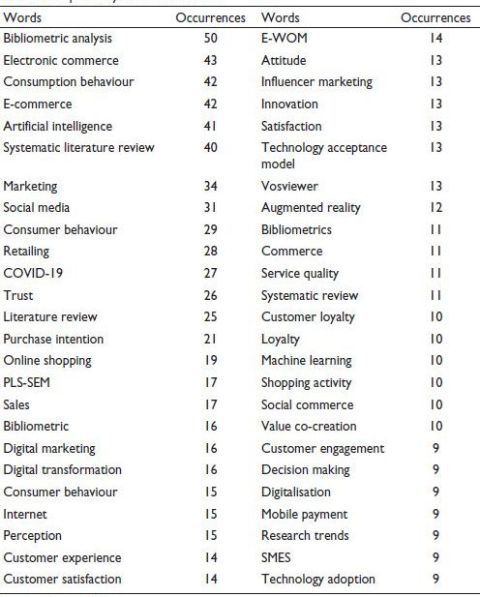
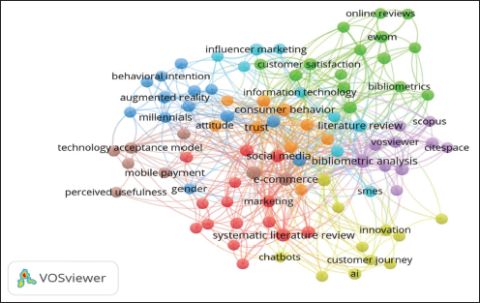
Table 4 presents 50 selected keywords from a pool of 3,129 sourced via Scopus, reflecting core themes in e-commerce and consumer behaviour research. Using VOSviewer, a bibliometric analysis was carried out to investigate the trends and intellectual structure in this field, producing Figure 9—a Keyword Occurrence Network Map. This map visualises clusters of frequently co-occurring keywords, where each node represents a unique author keyword, sized by its frequency and linked by edges that indicate the strength of co-occurrence, revealing thematic concentrations and conceptual linkages across the literature.
Table 4. Top-50 Keyword Occurrence.
Source: Scopus database.
In Figure 9, the keyword occurrence network is classified into distinct colour-coded clusters in which each colour represents a different thematic area within the research field. These colour-coded clusters are listed below:
Figure 9. Keyword Occurrences Network.
Source: Scopus database.
Core keywords and central themes: The most central and frequently co-occurring keywords in the network include e-commerce, social media, consumer behaviour, trust, bibliometric analysis and literature review. These terms form the conceptual core of the field, frequently appearing across clusters and acting as thematic bridges between different research streams. Their prominence indicates sustained scholarly interest and their foundational role in e-commerce literature.
Despite all of this, this analysis reveals the most prominent research gap that exist, that is the underrepresentation of regional contexts linking to the topic of e-commerce, whereby through Table 4 and Figure 9 it is clearly indicative that although themes and keywords such as; trust, adoption, satisfaction and technology acceptance are dominant, however most of it reflects a global concerns in e-commerce. In contrast, rural or regional specific keywords or themes, such as digital divide, rural logistics, or contextual barriers, occur far less frequently and remain weakly connected in the keyword co-occurrence map. This suggests that much of the scholarship is framed in generalised adoption models, and contextual factors in relation to rural e-commerce trends are often overlooked and remain underrepresented.
Conceptual Structure
Conceptual Construct (Thematic Map)
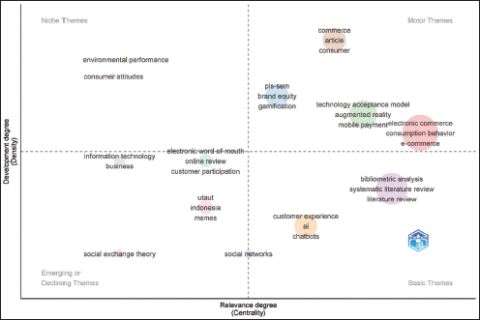
Using Biblioshiny (R-package), a thematic map was generated from Scopus data to classify research themes based on two dimensions: centrality (x-axis), indicating a theme’s relevance within the broader field, and density (y-axis), reflecting its internal development and structural maturity.
Based upon these two dimensions, the map is divided into four quadrants, which are listed as:
These themes are central and mature, reflecting the core of current e-commerce research. ‘Electronic commerce’ and ‘consumer behaviour’ appear as fundamental driving forces, suggesting high scholarly attention and structured development. These themes anchor the research in customer-centric and retail-driven digital commerce.
These themes are mature or deeply studied but isolated, often examined in-depth within narrow contexts. ‘Environmental Performance’ and ‘Consumer Attitude’ are frequently explored environmental and behavioural constructs, but appear less integrated with the emerging interdisciplinary area of e-commerce or social commerce. These may be important for specific sub-studies, such as consumer psychology or B2C models.
Figure 10. Thematic Map.
Source: Scopus database.
These themes are relevant and foundational, but lack the depth of internal cohesion. They may represent areas ready for more empirical work or theory development. Whereby, contexts such as ‘AI’ and ‘Customer engagement’ are critical in e-commerce research, but they may need more sophisticated models or interdisciplinary integration (e.g., trust, regulation).
This quadrant features emerging constructs like e-WOM and MSMEs, which show limited integration across the literature, highlighting opportunities to connect them with established themes, such as trust, regulation, and consumer behaviour. Concepts like Social Exchange Theory also appear here, often due to their methodological nature and lack of strong theoretical linkage.
The thematic map (Figure 10) also provides the clearest visual confirmation, which offers a critical lens through which it assesses the maturity of rural e-commerce research. Whereby it reveals that while themes or topics such as, ‘Electronic Commerce’ and ‘Consumer Behaviour’ appear as well-established motor themes, which indicates a mature and central body of research, however there is no corresponding motor themes which addresses rural-specific challenges such as, ‘Digital Divide’, ‘Trust Building in rural contexts’ or ‘Last-mile Logistics’ etc., which suggests that the application of established e-commerce knowledge to rural realities remains intellectually underdeveloped and that this concerns are either absent or relegated to emerging or peripheral clusters. This gap is usually not a result of a lack of relevance - rural consumers represent a significant untapped market—but of limited scholarly integration. This absence of a strong rural-focused cluster in the thematic map acts as a ‘smoking gun’, visually demonstrating that while the field has advanced around general adoption models and consumer experience, it has not yet adequately addressed the structural, cultural and infrastructural barriers that define rural participation in digital commerce.
Gaps and Opportunities
The bibliometric map reveals a significant gap in longitudinal and ethnographic research on rural e-commerce, whereby most studies are cross-sectional and urban-biased, with rural studies often treating the contexts of ‘rural’ as a homogenous category. Future research should explore:
There is also a lack of integration between technology adoption models and social-psychological frameworks in rural contexts.
Limitations in the Study
Although this bibliographic analysis on the topic of rural e-commerce, pertaining to the constructs of consumer experience, perception and loyalty has its own merits however there arise some limitations in the study that require more in-depth research and exploration. First and foremost, it is advisable and beneficial for future researchers to explore and expand their work in this research domain so as to offer a more complete and in-depth comprehension of the specific subject. The second concern is related to the stretch and range of the articles and papers used in constructing this bibliometric map, as only literature or publications that were indexed from the Scopus database were analysed, which means that publications which are not included in Scopus were not analysed.
Conclusion
This bibliometric analysis and report offers a thorough and comprehensive mapping of 19 years of scholarly contributions to e-commerce, with a particular focus on consumer experience, perception, and loyalty in rural contexts. The analysis reveals a sharp post-2020 surge in publications, driven by global digital transformation and pandemic-induced shifts in consumer behaviour. However, rural-specific challenges—such as digital literacy gaps, infrastructural limitations, and trust deficits—remain underrepresented in mainstream literature. Thematic clusters show emerging constructs like e-WOM and MSMEs with limited integration, indicating untapped research potential. Author collaboration networks highlight regional contrasts: Indian-origin scholars dominate in volume and focus on South Asian challenges, while European scholars, especially from Portugal and the UK, contribute more to customer-centric themes like satisfaction and service quality. Institutional analysis shows a mix of mature Western research hubs and rapidly growing Asian and Middle Eastern universities, reflecting global diversification. These findings highlight the necessity of context-sensitive tactics or strategies, interdisciplinary integration, and inclusive research agendas to reduce the digital divide between urban and rural areas and enhance the relevance and impact of e-commerce scholarship.
Practical Utility of the Study
This study presents significant practical contributions by offering a comprehensive bibliometric mapping of scholarly research on e-commerce with a focus on consumer experience, perception, and loyalty in rural regions. Through the use of advanced analytical tools such as VOSviewer and Biblioshiny, the research enables a systematic understanding of thematic evolutions, knowledge clusters, and collaborative patterns in the domain.
The bibliometric analysis reveals distinct author collaborations and regional research focuses, enabling targeted recommendations for e-commerce platforms. Indian-origin scholars emphasise South Asian challenges such as poor connectivity, low digital literacy, and trust deficits—suggesting the need for localised content, tailored loyalty programmes, and support systems to engage rural users. In contrast, European scholars, notably from Portugal and the UK, focus on customer-centric themes like satisfaction and service quality. Platforms in these regions should prioritise data-driven personalisation, omnichannel optimisation, and enhanced after-sales service to foster loyalty.
Furthermore, the identified fragmentation between logistics and consumer behaviour in the literature highlights a practical gap in which businesses should focus on innovating their last-mile delivery networks, such as by partnering with local postal services or small merchants, and then measuring the direct impact of this innovation on customer loyalty. The visualisation of underexplored areas, such as rural-specific digital behaviour and localised service expectations, usually offers entrepreneurs and digital retailers an empirical foundation for innovation.
Businesses can leverage this knowledge to tailor their marketing strategies, deploy region-specific customer engagement models, and foster long-term loyalty among rural consumers. Additionally, the study supports academic stakeholders in recognising influential authors and institutions as well as the potential gaps that are prevalent in this area of study, thereby guiding future collaboration and scholarly investments in rural e-commerce research.
Policy Implications
The outcomes of this bibliometric analysis carry notable implications for policymakers aiming to promote inclusive digital commerce in rural and semi-urban areas. The study reveals a critical gap in rural-specific research, highlighting the need for policies that address the unique socio-economic and infrastructural challenges faced by rural consumers.
The analysis also provides a robust evidence base to inform equitable, culturally sensitive and sustainable e-commerce policy development by highlighting where the scholarly gaps are most pronounced. Given the substantial scholarly contributions from scholars of Indian origin, the analysis suggests a pressing need for policymakers in South Asia to fund targeted research programmes on the digital divide, focusing especially on mobile-first solutions due to the rise of smartphone penetration. Policies in this region should incentivise e-commerce platforms to adopt strategies for ‘localised contents’ and ‘language support’ to address the cultural and language barriers noted in the literature, which would enhance ‘Perceived Ease of Use (TAM)’ and ‘Compatibility (DOI)’. In these contexts, disparities in internet access, digital literacy and last-mile delivery mechanisms underscore the urgency for strategic government intervention.
Meanwhile, for policymakers in highly-cited European countries such as Portugal and the United Kingdom, where research is more focused on mature concepts, the study’s findings indicate the importance of incorporating trust-building mechanisms and perceived value constructs—rooted in consumer psychology—into digital inclusion frameworks. By subsidising digital tools and incentivising local e-commerce platforms to offer regionally adapted services, policymakers can enhance adoption and engagement among rural users. Furthermore, there is a pressing need for regulatory frameworks that ensure data privacy, transaction transparency, and consistent service delivery in underserved regions. Encouraging public-private partnerships and targeted research funding will further solidify the digital participation of rural populations. In essence, this study offers a robust evidence base to inform equitable, culturally sensitive, and sustainable e-commerce policy development.
Declaration of Conflicting Interests
The authors declared no potential conflicts of interest with respect to the research, authorship and/or publication of this article.
Funding
The authors received no financial support for the research, authorship and/or publication of this article.
ORCID iDs
Invictus Kynta https://orcid.org/0009-0005-8617-8049
Durga Madhab Mahapatra https://orcid.org/0000-0003-1272-7285
Ajzen, I. (1991). The theory of planned behavior. Organizational Behavior and Human Decision Processes, 50(2), 179–211. https://doi.org/10.1016/0749-5978(91)90020-T
Anderson, R. E., & Srinivasan, S. S. (2003). E-satisfaction and e-loyalty: A contingency framework. Journal of the Academy of Marketing Science, 31(3), 241–258. https://doi.org/10.1177/0092070303031003002
Aria, M., & Cuccurullo, C. (2017). bibliometrix: An R-tool for comprehensive science mapping analysis. Journal of Informetrics, 11(4), 959–975. https://doi.org/10.1016/j.joi.2017.08.007
Bahl, R., & Kesharwani, S. (2020). Impact of perceived risk and trust on online shopping behaviour: A study from Indian perspective. International Journal of Management, 11(12), 3549–3567. https://doi.org/10.34218/IJM.11.12.2020.329
Bhatti, A. (2020). Online shopping behaviour model: A literature review and proposed model. International Journal of Business and Management, 15(5), 55–71. https://doi.org/10.5539/ijbm.v15n5p55
Choudhury, A. (2021). E-commerce constraints and opportunities in semi-urban India. Economic Perspectives, 13(2), 75–88.
Davenport, T., Guha, A., Grewal, D., & Bressgott, T. (2020). How artificial intelligence will change the future of marketing. Journal of the Academy of Marketing Science, 48, 24–42. https://doi.org/10.1007/s11747-019-00696-0
Davis, F. D. (1989). Perceived usefulness, perceived ease of use, and user acceptance of information technology. MIS Quarterly, 13(3), 319–340. https://doi.org/10.2307/249008
Donthu, N., Kumar, S., Mukherjee, D., Pandey, N., & Lim, W. M. (2021). How to conduct a bibliometric analysis: An overview and guidelines. Journal of Business Research, 133, 285–296. https://doi.org/10.1016/j.jbusres.2021.04.070
Garfield, E. (1979). Citation indexing: Its theory and application in science, technology, and humanities. Wiley.
Gefen, D., Karahanna, E., & Straub, D. W. (2003). Trust and TAM in online shopping: An integrated model. MIS Quarterly, 27(1), 51–90. https://doi.org/10.2307/30036519
Gulfraz, M. B., Sufyan, M., Mustak, M., Salminen, J., & Srivastava, D. K. (2022). Understanding the impact of online customers’ shopping experience on online impulsive buying: A study on two leading e-commerce platforms. Journal of Retailing and Consumer Services, 68, 103000.
Huang, Z., & Benyoucef, M. (2017). User experience in e-commerce: A review and future research agenda. Technological Forecasting and Social Change, 130, 117–133. https://doi.org/10.1016/j.techfore.2017.10.007
Ismagilova, E., Slade, E. L., Rana, N. P., & Dwivedi, Y. K. (2020). The effect of electronic word of mouth communications on intention to buy: A meta-analysis. Information Systems Frontiers, 22, 1203–1226. https://doi.org/10.1007/s10796-019-09924-y
Kim, C., Mirusmonov, M., & Lee, I. (2010). An empirical examination of factors influencing the intention to use mobile payment. Computers in Human Behavior, 26(3), 310–322. https://doi.org/10.1016/j.chb.2009.10.013
Kumar, A., Sinha, A., & Sinha, A. (2021). Digital inclusion and rural e-commerce: A study of challenges and enablers in India. Technological Forecasting and Social Change, 173, 121119. https://doi.org/10.1016/j.techfore.2021.121119
Kumar, V., & Dange, U. (2022). Evolution of e-commerce in India: Trends and consumer insights. Indian Journal of Marketing, 52(1), 8–23. https://doi.org/10.1080/0267257X.2013.815299
Laudon, K. C., & Traver, C. G. (2008). E-commerce: Business, technology, and society (4th ed.). Pearson Education.
Lemon, K. N., & Verhoef, P. C. (2016). Understanding customer experience throughout the customer journey. Journal of Marketing, 80(6), 69–96. https://doi.org/10.1509/jm.15.0420
Luo, X., Tong, S., Fang, Z., & Qu, Z. (2019). Machines vs. humans: The impact of artificial intelligence chatbot disclosure on customer purchases. Marketing Science, 38(6), 937–947. https://doi.org/10.1287/mksc.2019.1192
Mishra, P. K. (2023). Serving rural market via e-commerce: A study for consumer durables. Management Theory and Studies for Rural Business and Infrastructure Development, 45(2), 142–151. https://doi.org/10.15544/mts.2023.15
Patel, K., & Verma, S. (2021). Strategies for enhancing e-commerce adoption in rural India: A consumer-centric approach. International Journal of E-Business Research, 17(4), 45–63. https://doi.org/10.4018/IJEBR.2021100103
Paul, C. (2025). Role of digital marketing strategies in influencing rural and semi-urban consumer purchases. ResearchGate. Retrieved, 8 January 2026, from https://www.researchgate.net/publication/387855697_Role_of_Digital_Marketing_Strategies_in_
Influencing_Rural_and_Semi-Urban_Consumer_Purchases
Ren, Y., Zhang, L., & Chen, M. (2020). Personalization in digital commerce: The role of analytics in shaping customer experience. Journal of Business Research, 115, 245–256.
Rita, P., Oliveira, T., & Farisa, A. (2019). The impact of e-service quality and customer satisfaction on customer behaviour in online shopping. Heliyon, 5(10), e02690.
Rogers E. M. (2003). Diffusion of innovations (5th ed.). Free Press.
Rose, S., Clark, M., Samouel, P., & Hair, N. (2012). Online customer experience in e-retailing: An empirical model of antecedents and outcomes. Journal of Retailing, 88(2), 308–322. https://doi.org/10.1016/j.jretai.2012.03.001
Scilit. (2025). Journal of Business Research publication statistics. Retrieved, 23 September 2025, from https://www.scilit.com/sources/729
Singh, R., & Srivastava, A. (2022). Urban bias in digital commerce: A comparative study of rural and metropolitan adoption patterns. Journal of Digital Marketing Research, 14(3), 112–128.
Srivastava, M., & Dey, S. (2021). E-retailing loyalty: The impact of trust and service quality. International Journal of Retail & Distribution Management, 49(4), 501–521. https://doi.org/10.1108/IJRDM-04-2020-0113
Van Eck, N. J., & Waltman, L. (2010). Software survey: VOSviewer, a computer program for bibliometric mapping. Scientometrics, 84, 523–538. https://doi.org/10.1007/s11192-009-0146-3
Venkatesh, V., & Davis, F. D. (2000). A theoretical extension of the technology acceptance model: Four longitudinal field studies. Management Science, 46(2), 186–204. https://doi.org/10.1287/mnsc.46.2.186.11926
Venkatesh, V., Morris, M. G., Davis, G. B., & Davis, F. D. (2003). User acceptance of information technology: Toward a unified view. MIS Quarterly, 27(3), 425–478. https://doi.org/10.2307/30036540
