MDIM Journal of Management Review and Practice

P. Murugan1
Post Graduate and Research Department of Commerce, Vivekananda College, Tiruvedakam West, Madurai, Tamil Nadu, India

Creative Commons Non Commercial CC BY-NC: This article is distributed under the terms of the Creative Commons Attribution-NonCommercial 4.0 License (http://www.creativecommons.org/licenses/by-nc/4.0/) which permits non-Commercial use, reproduction and distribution of the work without further permission provided the original work is attributed.
This article explores the concept of Industry 5.0 and its implications for the manufacturing industry. Industry 5.0 represents a paradigm shift that emphasizes the collaboration between humans and advanced technologies to revolutionize manufacturing processes. The article aims to investigate the potential benefits, challenges, and future impact of Industry 5.0. Through primary data collection, including surveys among industry professionals and experts, the study provides insights into the potential benefits of Industry 5.0. The data analysis reveals that improved quality control, faster time to market, and increased productivity are perceived as significant potential benefits. However, respondents rated ‘improved customer experience’ as a relatively less prominent benefit. Other important benefits include enhanced innovation, customization and personalization, and sustainability and resource efficiency. The study also highlights challenges hindering the widespread adoption of Industry 5.0. These challenges include the need for upskilling and reskilling the workforce, ensuring data privacy and security, and managing the transition from existing manufacturing systems. Based on the findings, the article emphasizes the transformative nature of Industry 5.0, enabling greater customization, flexibility, and sustainability in manufacturing processes. It highlights the importance of human–machine collaboration and the empowerment of workers to leverage their creativity and problem-solving skills alongside advanced technologies. To successfully implement Industry 5.0, organizations need to address challenges and consider recommendations provided in the article. This includes investing in workforce upskilling, ensuring data privacy and security measures, and managing the transition process effectively. In conclusion, Industry 5.0 has the potential to redefine manufacturing processes, driving innovation and sustainability across various industries. By embracing the principles of customization, sustainability, and human ingenuity, the manufacturing sector can adapt and thrive in the future.
Industry 5.0, manufacturing, customization, sustainability, human–machine collaboration, innovation
Introduction
In the ever-evolving landscape of industrial development, the concept of Industry 5.0 has emerged as the next frontier of manufacturing. Building upon the advancements of Industry 4.0, this paradigm shift represents a fusion of human ingenuity with cutting-edge technologies to revolutionize the way we design, produce, and distribute goods. This article aims to explore the concept of Industry 5.0, its significance in the context of the manufacturing sector, and present primary data insights to shed light on its potential impact on various industries.
The landscape of industrial development is in a state of perpetual transformation. The journey from Industry 1.0, characterized by mechanization, to Industry 4.0, defined by digitalization and automation, has led us to the cusp of a new era in manufacturing known as Industry 5.0. In this era, the synthesis of human ingenuity and cutting-edge technologies is poised to reshape the manufacturing sector. It represents a collaborative revolution where humans and technology work hand in hand, transforming the way we conceptualize, create, and disseminate products.
This article delves into the exciting concept of Industry 5.0 and explores its profound implications for the manufacturing sector and beyond. As Industry 4.0 laid the groundwork for the digitalization of factories and processes, Industry 5.0 goes a step further, emphasizing the synergy between human intelligence and advanced technologies. The synergy, as described by Chryssolouris (2020), leads to what can be termed a “Human–Technology Collaboration Revolution.” It’s a concept that beckons us to reimagine manufacturing processes and engage in a new era of human-technology collaboration.
The advent of Industry 5.0 couldn’t be timelier. In today’s fast-paced world, as highlighted by the World Economic Forum (2020), the need to shape the future of advanced manufacturing and production has become increasingly pressing. Recommendations from experts like Kagermann et al. (2013) stress the strategic importance of initiatives like INDUSTRIE 4.0, which laid the foundation for what Industry 4.0 has become.
As we move forward into Industry 5.0, an understanding of its implications extends beyond the factory floor. It influences business operations, management, and even society. The research by Laakso and Vuori (2020) is pivotal in unraveling the implications of Industry 4.0 and Society 5.0 on various aspects of business.
Schumacher and Sauter (2021) shed light on the specifics of Industry 5.0’s “Human-Machine Collaboration.” Exploring the needs and opportunities in this domain becomes crucial as we usher in this new era.
Furthermore, in a world increasingly concerned about sustainability, Tschirky and Dach (2019) have reviewed the sustainable aspects of manufacturing in the context of Industry 4.0. The question naturally arises: how will Industry 5.0 contribute to sustainable manufacturing? The study by Ganz and Schüßler (2021) explores this very relationship.
Additionally, the transition to Industry 5.0 has profound implications for manufacturing processes and value networks. Westkämper et al. (2021) provide valuable insights into the transformation of factories into “Smart Factories” and the evolution of value networks.
The journey from Industry 4.0 to Industry 5.0 is not just a leap in terminology, but a leap in possibilities and potentials. It is about enabling smart human-technology collaboration, transforming manufacturing, and influencing sustainability. It opens doors to innovative value networks and redefines the future of manufacturing.
In this exploration of Industry 5.0, we embark on a quest to understand the essence of this revolution and its potential impact on the manufacturing and industrial landscape.
Statement of the Problem
Traditional manufacturing processes have often focused on automation and efficiency, resulting in a decrease in the importance of human involvement. However, this approach has presented challenges in terms of flexibility, customization, and the integration of emerging technologies. Industry 5.0 seeks to address these concerns by emphasizing the collaboration between humans and advanced technologies, enabling a new era of intelligent, sustainable, and human-centric manufacturing.
Scope
This article focuses on Industry 5.0 and its implications for the manufacturing industry. It aims to highlight the core principles and characteristics of Industry 5.0 and examine its potential benefits, challenges, and future impact.
Objectives
The objectives of this article are as follows:
Investigate the potential benefits of Industry 5.0 in terms of productivity, innovation, enhanced customer experiences, and the adaptation level.
Identify the challenges and obstacles hindering the widespread adoption of Industry 5.0 in the manufacturing sector.
Provide suggestions and recommendations for organizations to embrace and implement Industry 5.0 principles successfully.
Methodology
To gather primary data for this article, a combination of qualitative and quantitative research methods was employed. Surveys were conducted among industry professionals, manufacturing organizations, and technology experts to gather insights on the adoption, challenges, and benefits of Industry 5.0. 350 experts in the manufacturing field were selected based on simple random sampling.
Data Analysis
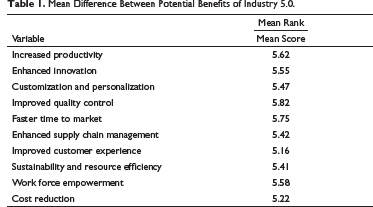
Interpretation of Table 1
Table 1 presents the mean scores and ranks for different potential benefits of Industry 5.0. The variables listed include increased productivity, enhanced innovation, customization and personalization, improved quality control, faster time to market, enhanced supply chain management, improved customer experience, sustainability and resource efficiency, workforce empowerment, and cost reduction.
The mean scores represent the average rating given by the respondents for each variable on a scale of 1 to 7, with higher scores indicating a stronger agreement with the potential benefits.
Based on the mean scores, the variable with the highest mean score is ‘improved quality control’ (mean score = 5.82), indicating that respondents perceived it as the most significant potential benefit of Industry 5.0. This is followed by ‘faster time to market’ (mean score = 5.75) and ‘increased productivity’ (mean score = 5.62), which also received high mean scores.
On the other hand, the variable with the lowest mean score is ‘improved customer experience’ (mean score = 5.16), suggesting that respondents rated it as a relatively less prominent potential benefit of Industry 5.0. Other variables such as sustainability and resource efficiency (mean score = 5.41), enhanced supply chain management (mean score = 5.42), and cost reduction (mean score = 5.22) received moderate mean scores.
The mean ranks provide an additional perspective on the variables. However, without the full distribution of rankings, it is difficult to draw specific conclusions based solely on the mean ranks.
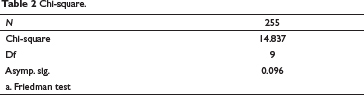
Interpretation of Table 2
Table 2 presents the results of a chi-square test conducted with a sample size of 255 respondents. The chi-square value obtained is 14.837, with 9 degrees of freedom. The p-value (asymp. sig.) associated with this test is 0.096.
The chi-square test is a statistical test used to determine if there is a significant association between variables. In this case, the chi-square test was likely conducted to examine the relationship between different variables and categories.
The obtained p-value of 0.096 suggests that there may not be a statistically significant association between the variables tested at the conventional significance level (e.g., α = 0.05). However, further investigation or a larger sample size may be needed to make definitive conclusions.
It is important to note that the interpretation of the chi-square test results should take into account the specific research question, hypotheses, and the context of the study.
SEM Analysis
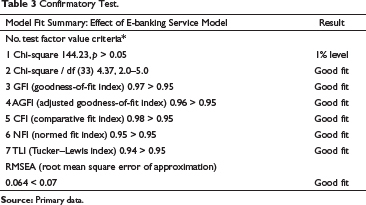
The confirmatory test result showed a good fit as shown in Table 3. Adaptation level and the challenges faced and the benefits are compared in this analysis.
A model is said to fulfill the criteria of goodness of fit if it satisfies certain values which are given in Table 3. Based on these values, the estimated value for the model is 4.370, which satisfies the required condition. Similarly, the required value of the RMSEA should be less than 0.07. Against this value, the estimated model value is 0.065, which highly validates the result. Similarly, model fit indices (GFI = 0.97, AGFI = 0.96, CFI = 0.98, NFI = 0.95, and TLI = 0.94) for this model indicate that the model fits well.
Suggestions and Recommendations for Organizations to Embrace and Implement Industry 5.0 Principles Successfully
Foster a culture of innovation: Encourage a culture of innovation within the organization by promoting collaboration, creativity, and risk-taking. Create channels for employees to contribute ideas and provide incentives for innovative thinking.
Invest in workforce training and development: Recognize the importance of upskilling and reskilling the workforce to adapt to the changes brought by Industry 5.0. Provide training programs and resources to enhance employees' digital literacy, technical skills, and problem-solving abilities.
Collaborate with technology providers: Establish partnerships or collaborations with technology providers and experts in emerging technologies. Stay updated on the latest advancements and leverage their expertise to integrate cutting-edge technologies into your manufacturing processes effectively.
Ensure data privacy and security: As Industry 5.0 relies heavily on data collection, analysis, and connectivity, organizations must prioritize data privacy and security. Implement robust cyber security measures, including encryption, access controls, and regular audits, to protect sensitive information.
Establish cross-functional teams: Create cross-functional teams comprising professionals from various departments, such as engineering, production, IT, and marketing. Encourage collaboration and knowledge sharing to drive innovation and ensure a holistic approach to implementing Industry 5.0 principles.
Pilot projects and proof of concepts: Start with small-scale pilot projects to test the feasibility and effectiveness of Industry 5.0 initiatives. Gather data, measure performance metrics, and analyze the outcomes to refine and improve the implementation strategy before scaling up.
Foster collaboration between humans and machines: Emphasize the importance of human–machine collaboration in the manufacturing process. Encourage employees to embrace and leverage technology as a tool to enhance their productivity, creativity, and problem-solving capabilities.
Embrace sustainability and resource efficiency: Integrate sustainable practices and resource-efficient processes into your manufacturing operations. Focus on reducing waste, optimizing energy consumption, and adopting circular economy principles to minimize environmental impact.
Engage with industry networks and associations: Participate in industry networks, conferences, and associations focused on Industry 5.0. Engage in knowledge sharing, stay informed about industry trends, and collaborate with peers to accelerate the adoption of Industry 5.0 principles.
Continuously monitor and evaluate progress: Regularly monitor and evaluate the progress of Industry 5.0 initiatives within your organization. Use key performance indicators to measure the impact on productivity, innovation, customer experience, and sustainability. Adapt and refine your implementation strategy based on the findings.
Conclusion
Industry 5.0 represents a transformative shift in the manufacturing industry, emphasizing the collaboration between humans and advanced technologies. By leveraging the benefits of customization, sustainability, and human ingenuity, Industry 5.0 has the potential to redefine manufacturing processes and drive innovation across various industries. However, addressing challenges such as workforce upskilling and data security will be crucial for successful implementation. Embracing the principles of Industry 5.0 will pave the way for a future where manufacturing is not only efficient but also adaptive, sustainable, and human-centric.
Declaration of Conflicting Interests
The author declared no potential conflicts of interest with respect to the research, authorship and/or publication of this article.
Funding
The author received no financial support for the research, authorship and/or publication of this article.
ORCID iD
P. Murugan https://orcid.org/0009-0004-2913-4843
Chryssolouris, G. (2020). Industry 5.0: The human–technology collaboration revolution. The International Journal of Advanced Manufacturing Technology, 108(1–2), 421–428.
Ganz, W., & Schüßler, F. (2021). Sustainability and industry 5.0: An explorative study on the relationship between human–technology interaction and sustainable manufacturing. Sustainability, 13(10), 5420.
Jazdi, N. (2014). Cyber-physical systems in the context of Industry 4.0. In 2014 IEEE International Conference on Automation, Quality and Testing, Robotics (AQTR), 1–4.
Kagermann, H., Wahlster, W., & Helbig, J. (2013). Recommendations for implementing the strategic initiative Industrie 4.0: Final report of the Industrie 4.0 Working Group. https://www.acatech.de/wp-content/uploads/2018/03/Industrie4.0_engl.pdf
Laakso, M., & Vuori, V. (2020). Implications of industry 4.0 and society 5.0 on business and operations management. In Proceedings of the 29th International Conference on Management of Technology (IAMOT), 10–14.
PwC. (2020). Industry 4.0: Building the digital enterprise. https://www.pwc.com/gx/en/industries/industries-4.0/landing-page/industry-4.0-building-the-digital-enterprise-april-2020.pdf
Schumacher, A., & Sauter, P. (2021). Industry 5.0: Human–machine collaboration: Understanding the needs and opportunities. In 2021 IEEE 16th International Conference on Automation Science and Engineering (CASE), 377–382.
Tschirky, H., & Dach, S. U. (2019). Sustainable manufacturing in the context of industry 4.0: A review. Sustainability, 11(7), 2044.
Westkämper, E., Kagermann, H., & Wolfgang, W. (2021). Industry 5.0: Smart factories and value networks. https://www.acatech.de/wp-content/uploads/2021/01/Industry-5.0-Smart-Factories-and-Value-Networks.pdf
World Economic Forum. (2020). Shaping the future of advanced manufacturing and production. https://www.weforum.org/reports/shaping-the-future-of-advanced-manufacturing-and-production
