
MDIM Journal of Management Review and Practice


Mohammad Zulqar Nain1, Mohammed Ali1, Mehfooz Zaki1 and Fahad1
1Department of Commerce, Aligarh Muslim University, Aligarh, Uttar Pradesh, India

Creative Commons Non Commercial CC BY-NC: This article is distributed under the terms of the Creative Commons Attribution-NonCommercial 4.0 License (http://www.creativecommons.org/licenses/by-nc/4.0/) which permits non-Commercial use, reproduction and distribution of the work without further permission provided the original work is attributed.
This study explores the evolving role of sustainability as a strategic innovation within modern businesses and its impact on investor attitudes and decision-making. As organisations increasingly integrate sustainable practices into their operations, these initiatives influence corporate strategy and financial performance. Through an extensive literature review, the article examines the role of sustainability in strategic management, highlighting the drivers that push companies toward adopting sustainable practices and the innovative approaches emerging in business models. The research also delves into the importance of sustainability reporting and transparency, shedding light on its effect on corporate accountability and investor confidence. A key focus is placed on the financial benefits of solid sustainability practices, supported by evidence from various studies and case examples demonstrating how such practices enhance economic performance and influence investor decisions. Finally, the article addresses sustainability’s challenges, criticisms and implications, providing a comprehensive view of its strategic significance in the financial landscape
Sustainability, strategic management, stakeholder expectations, long-term value creation
Introduction
Sustainability as a strategic innovation involves businesses adopting practices that consider environmental, social and economic impacts in their decision-making. It goes beyond being eco-friendly; it’s about integrating responsible and ethical practices into a company’s operations. Businesses invent themselves by figuring out how to expand and prosper while contributing to society and the environment. This strategy seeks long-term benefits for the entire world, not just for business (Stanislavyk & Zamlynskyi, 2023). As people become more conscious of environmental challenges, social responsibility and the necessity of ethical corporate operations, sustainability in business becomes increasingly important. Enterprises realise that incorporating sustainability tackles global concerns, improves reputation, draws customers and reduces risks, as consumers and investors prioritise value-aligned options. Changing market dynamics and regulatory pressures highlight how important it is for companies to embrace sustainability as a critical component of long-term success (Elhoushy & Jang, 2023).
Understanding how sustainability affects investor attitudes is crucial for several reasons. First, investors increasingly consider environmental, social and governance (ESG) factors in their decision-making process. Companies with strong sustainability practices may attract a growing segment of investors focused on responsible and ethical investments. Second, sustainability performance can impact a company’s long-term financial performance and risk management. Investors are becoming more aware that businesses with sustainable practices may be better positioned to navigate environmental and social challenges, ultimately safeguarding their investments. Additionally, as regulatory requirements and reporting standards related to sustainability increase, investors need to assess how thriving companies comply with these standards. Awareness of a company’s sustainability efforts can provide investors insights into its resilience, ethical stance and commitment to responsible business practices (Ferri et al., 2023).
Literature Review
In the literature on sustainability as a strategic innovation, researchers have extensively examined integrating sustainable practices into business strategies. Research indicates that sustainability favours a company’s long-term financial success, competitive advantage and reputation. The scholarly literature highlights the significance of sustainability in moulding the culture of organisations, stimulating creativity and meeting stakeholders’ expectations. Researchers also look at the difficulties in implementing sustainable plans and the requirement for efficient reporting and assessment systems. To date, the body of research highlights the many advantages and challenges of using sustainability as a fundamental element of strategic innovation in business.
The literature on sustainability as a strategic innovation reflects a growing body of research that recognises the transformative impact of sustainability on business strategy. A brief exploration of key themes in existing literature is presented in Table 1.
Table 1. Brief of Literature Work on Key Themes.
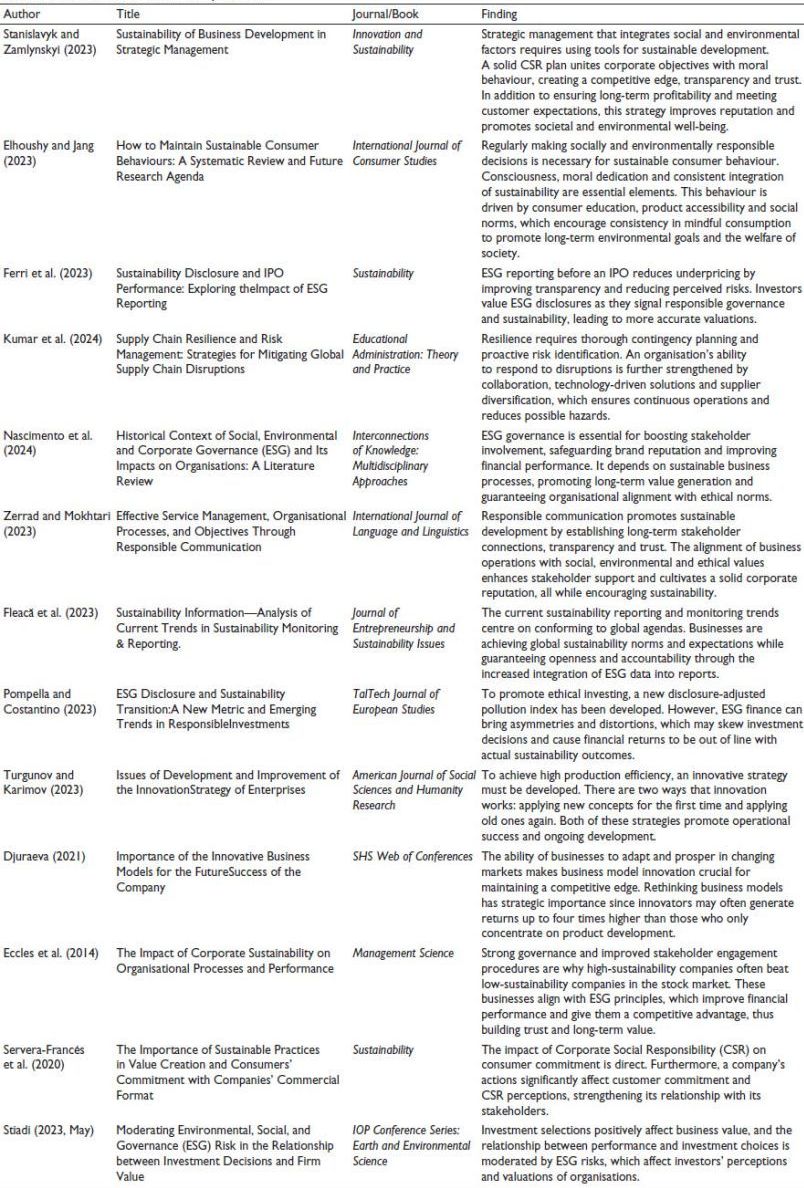
These theories and frameworks provide additional perspectives on integrating sustainability into business strategy. They cover various psychological and organisational resilience dimensions, offering a comprehensive view of the intersection between sustainability and strategic management.
The literature that is currently available on sustainability as a strategic innovation has a few things that could be improved and points of disagreement. A few of them are as follows.
The Role of Sustainability in Strategic Management
The role of sustainability in strategic management is pivotal, influencing how organisations create, implement and adapt their strategies to achieve long-term success. Sustainability is integrated into strategic decision-making processes to address ESG concerns, aligning business goals with broader societal and ecological objectives. Companies adopting sustainable strategic management prioritise responsible resource use, ethical practices and stakeholder engagement. Sustainability considerations guide innovation, risk management and supply chain practices, enhancing resilience and fostering positive relationships with customers, investors and communities (Kumar et al., 2024). Ultimately, sustainability in strategic management is a transformative force that creates value, a competitive advantage and a positive societal impact.
Sustainability is integrated into strategic management by systematically incorporating ESG considerations at every stage. In the formulation phase, organisations assess their impact on the environment, social stakeholders and governance structures (Nascimento et al., 2024). This involves identifying key sustainability risks and opportunities relevant to the industry and aligning them with the overall business strategy. In the planning stage, sustainable objectives and targets are set, outlining specific actions to address identified ESG factors. The implementation phase involves integrating sustainability into daily operations, supply chain management and product development. Companies often establish key performance indicators to measure progress towards sustainability goals. In the evaluation and control phase, ongoing monitoring and reporting mechanisms are implemented to track performance, enabling continuous improvement and adaptation of strategies to changing sustainability landscapes. Overall, sustainability becomes a guiding principle, influencing strategic decisions, fostering innovation and ensuring long-term value creation while meeting stakeholders’ expectations and contributing to a positive societal impact.
Drivers for Sustainable Practices
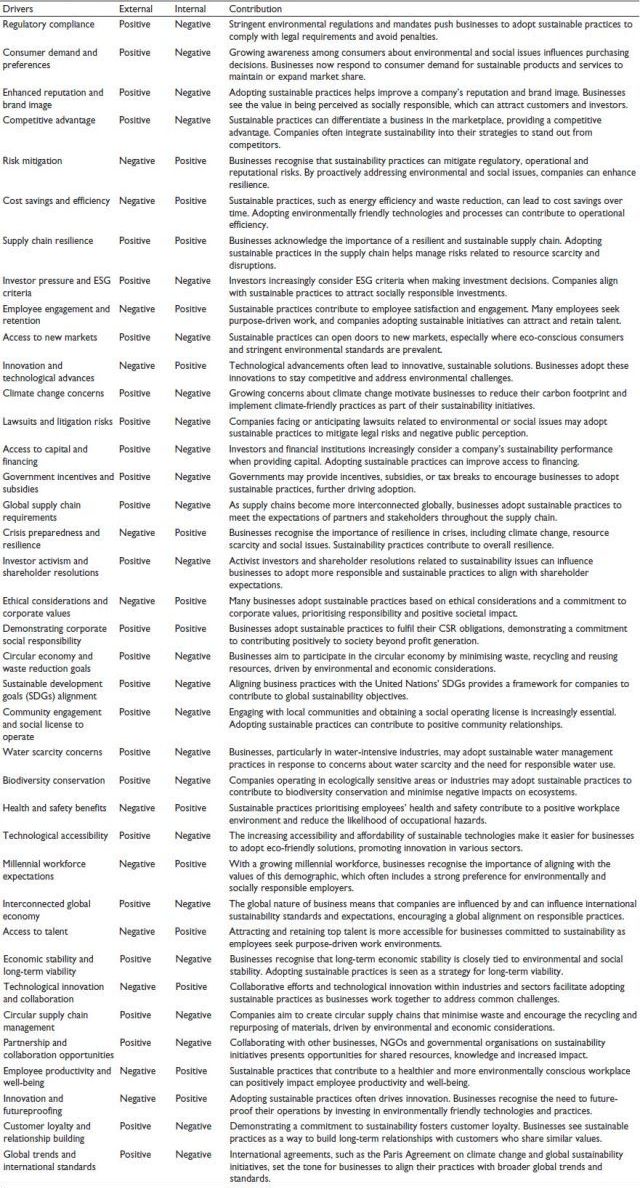
Businesses adopt sustainable practices for various reasons, driven by internal and external factors. Key factors contributing to adopting sustainable practices are depicted in Table 2.
Today’s businesses must deal with a variety of factors that encourage the adoption of sustainable practices. Businesses are under regulatory pressure to include sustainability to avoid fines, preserve their legal standing and satisfy other obligations arising from environmental legislation and legal requirements. Simultaneously, increasing consumer demands for socially and environmentally conscious products push companies to adopt sustainability to satisfy changing consumer wants. Using sustainable practices gives businesses a competitive edge in the market and appeals to customers who value making ethical decisions and meeting legal and customer requirements. Enterprises are further encouraged to align with sustainability by investors’ growing attention to ESG considerations, which attract investment and improve financial performance. Businesses implementing sustainable practices are further motivated by their commitments under the CSR framework, which goes beyond generating profits to benefit society. Firms in an integrated global economy must stay relevant and competitive by adhering to global sustainability trends and norms.
Innovative Practices in Sustainable Business Models
Companies are increasingly redefining their products, services, and operations to align with sustainability goals as part of their environmental and social responsibility commitment (Sono et al., 2023; Zerrad & Mokhtari, 2023). Here is how this transformation is taking place:
Product Innovation
Eco-friendly Materials
Companies are adopting sustainable and recyclable materials in product design to minimise environmental impact.
Durability and Repairability
Products are designed to be durable and easily repairable, promoting a shift away from disposable and single-use items.
Table 2. Factors Contributing to the Adoption of Sustainable Practices.
Energy Efficiency
Energy-efficient features are integrated into products, reducing energy consumption and lowering carbon footprints.
Circular Economy Practices
Product Life Extension
Companies are developing strategies to extend the life of products through repair, refurbishment and recycling.
Take-Back Programmes
Some companies implement take-back programmes, encouraging customers to return used products for recycling or repurposing.
Sustainable Services and Business Models
Subscription Services
Businesses offer subscription models, providing access to services rather than ownership, reducing overall resource consumption.
Sharing Platforms
Companies participate in the sharing economy, facilitating the shared use of goods and services to maximise utility and minimise waste.
Green Supply Chain Management
Supplier Engagement
Companies collaborate with suppliers to ensure sustainable and ethical materials sourcing.
Transportation Efficiency
Optimisation of transportation routes and modes to reduce carbon emissions in the supply chain.
Renewable Energy Integration
On-site Renewable Energy
Companies invest in on-site renewable energy sources, such as solar panels and wind turbines, to power their operations sustainably.
Carbon-Neutral Operations
Some businesses aim to achieve carbon neutrality by offsetting them.
Employee and Community Engagement
Employee Sustainability Training
Companies train employees on sustainable practices, fostering a culture of responsibility.
Community Initiatives
Engaging with local communities through sustainability initiatives and contributing to social and environmental well-being.
Sustainability Reporting and Transparency
Companies employ various communication strategies to convey their sustainability initiatives to investors and the wider public. Here is an overview of common approaches.
Businesses increasingly prioritise accountability and transparency by sharing information about their sustainability initiatives via various platforms. An organisation’s ESG performance is detailed in annual sustainability reports, a standard practice. They show goals, accomplishments and a company’s overall commitment to sustainability. To highlight the connections between these aspects, some businesses now include sustainability measurements in their financial performance indicators in an integrated annual report (Fleac.png) et al., 2023). Corporate websites have dedicated parts that provide policies, procedures and progress in an easily readable format, all to serve stakeholders better. Moreover, businesses use conferences, earnings calls and investor presentations to highlight their sustainability projects and let investors know how committed they are to ethical business practices.
et al., 2023). Corporate websites have dedicated parts that provide policies, procedures and progress in an easily readable format, all to serve stakeholders better. Moreover, businesses use conferences, earnings calls and investor presentations to highlight their sustainability projects and let investors know how committed they are to ethical business practices.
Businesses also include a sustainability message in their branding and marketing materials to demonstrate their dedication to moral business conduct. Businesses that use these strategies will enhance their reputations and contribute to the greater narrative of supporting ecologically and socially responsible business practices.
Impact on Financial Performance
A company’s financial performance is greatly improved by embracing ESG issues since they increase capital access and lower financing costs. Consumers and investors, especially younger generations, are favouring companies with strong sustainability policies more and more because they value sustainability more than just financial measures (Pompella & Costantino, 2023). In addition to having a favourable impact on stock performance and sales, this alignment with stakeholder preferences also encourages innovation and adaptation within the organisation. To meet changing market demands, businesses can improve their financial performance by creating and refining their innovation strategies and launching new goods, services and business models that promote productivity, competitiveness and long-term success (Djuraeva, 2021). High-sustainability businesses use their methods to set themselves apart from the competition and obtain a competitive edge that increases market share and boosts customer loyalty—which benefits both financial performance and stock market success (Eccles et al., 2014). By exposing a company’s dedication to sustainability, sustainable marketing improves a company’s credibility, reputation and customer connections. Businesses that implement sustainable practices tend to attract younger generations, especially Millennials and Gen Z, who place a high importance on authenticity and openness. These generations tend to believe in and stick with businesses that show sincere dedication to corporate social responsibility (Servera-Francés et al., 2020).
Sustainability is critical to building strong relationships with consumers, employees and communities outside of business. These connections improve the company environment and boost financial results. By tackling social and environmental issues early, businesses can adapt to changing regulations, reduce legal risks and maintain economic stability. Sustainable practices also help companies stand out, supporting ethical and compliant operations that lead to long-term profits.
Financial Benefits of Strong Sustainability Practices: Evidence from Studies and Cases
Studies Demonstrating Positive Financial Outcomes
Harvard Business Review (HBR) Study
The HBR study, The Impact of Corporate Sustainability on Organizational Processes and Performance’, found a positive correlation between sustainability practices and financial performance in a comprehensive analysis of 180 companies.
MIT Sloan Management Review and BCG Report
The joint report, ‘Sustainability: The “Embracers” Seize advantage’, by MIT Sloan Management Review and Boston Consulting Group, highlights that ‘embracing sustainability leads to higher market valuation, lower volatility, and improved performance’.
University of Oxford Study
The University of Oxford’s ‘From the Stockholder to the Stakeholder’ study analysed 200 academic papers and found a strong business case for sustainability, indicating that companies with robust ESG performance exhibit better financial results.
Cases Demonstrating Positive Financial Outcomes
Unilever
Unilever’s sustainable living brands, including Dove and Ben & Jerry’s, outperformed the average growth rate in 2018. Unilever’s commitment to sustainability and purpose-driven branding has increased consumer trust and market share.
Tesla
Tesla’s focus on sustainable energy solutions, electric vehicles and solar products has aligned with environmental goals and propelled the company’s financial success. Tesla’s market value and stock performance have surged, reflecting investor confidence in sustainable innovation.
Interface Inc
The carpet manufacturer Interface transformed its business with a commitment to sustainability, achieving a nearly 60% reduction in greenhouse gas emissions and positively impacting its financial bottom line. The company’s sustainability initiatives have been a key driver of market success.
Nestlé
Nestlé’s emphasis on sustainable sourcing, including responsible water use and supply chain practices, has improved brand reputation and customer loyalty. The company’s financial performance reflects the positive impact of these sustainability efforts.
Danone
Danone’s ‘One Planet. One Health’ sustainability agenda has translated into increased sales of its health-focused products. The company’s financial success is linked to consumer preference for products aligned with environmental and social responsibility.
These studies and cases underscore the positive financial outcomes of strong sustainability practices. Companies prioritising ESG factors contribute to global goals and experience tangible benefits in market performance, brand value and investor confidence.
Investor Attitudes and Decision-making
Sustainability significantly influences investor attitudes and decision-making, which is pivotal in shaping investment strategies. Investors increasingly consider ESG factors as integral components of risk assessment and long-term value creation. Companies with strong sustainability practices are perceived as more resilient, ethical and aligned with global trends, attracting socially responsible investors. Pompella and Costantino (2023) and Stiadi (2023) suggested that investor confidence is further reinforced by positive ESG performance, which indicates efficient operations and competent risk management. Investors progressively integrate ESG factors into their decision-making processes as sustainability becomes more central to investment strategies. In addition to increasing financial returns, this alignment with global trends promotes a more ethical and sustainable economy by drawing socially conscious investors to businesses that exhibit morally sound and resilient operations.
Incorporating ESG criteria to improve long-term financial performance and reduce risks is a developing trend in socially responsible investing (SRI), which reflects a shift in investor preferences. This change in demand for ESG-focused funds impacts investment prospects (Slapikaite & Tamosiuniene, 2013). The result is a shift in capital flows towards businesses and initiatives that support sustainability objectives, which raises the demand for investments with an emphasis on ESG. From a specialised strategy to a popular one, SRI has changed the face of investing and pushed businesses to use ethical business practices to draw in and hold onto capital. The effects of corporate operations on society and the environment are becoming more widely recognised due to this change.
The impact of SRI on capital flows extends beyond individual investor portfolios to institutional investors, asset managers and pension funds. These entities are increasingly integrating ESG considerations into their investment strategies, further amplifying the influence of SRI on capital allocation. As sustainability becomes a key driver of investment decisions, companies adopting strong ESG practices will likely benefit from enhanced access to capital, lower financing costs and increased market value. The trend also underscores a broader societal shift towards recognising the interdependence of financial success and responsible corporate behaviour, signalling a new era where capital is directed towards businesses prioritising profit and positive societal impact.
Challenges and Criticisms
Cost Considerations
One of the primary challenges businesses face in implementing sustainable practices is the perceived or actual cost of adopting environmentally friendly technologies, materials, and processes. Initial investments in sustainability measures can be substantial, and companies may encounter resistance due to concerns about short-term financial impacts, especially for small and medium-sized enterprises.
Complex Supply Chains
Businesses with intricate and global supply chains often face challenges in ensuring the sustainability of every component. Sourcing sustainable materials and verifying the ethical practices of suppliers can be complex, requiring increased transparency and collaboration throughout the supply chain, which may pose logistical and organisational hurdles.
Regulatory Uncertainty
Rapid changes in environmental regulations and sustainability standards can create uncertainty for businesses. Compliance with evolving requirements demands continuous adaptation, and navigating a dynamic regulatory landscape may pose challenges, particularly for companies operating in multiple jurisdictions with varying sustainability frameworks.
Resistance to Change and Organisational Culture
Resistance to change within an organisation, coupled with the need to reshape existing practices, can hinder the adoption of sustainable initiatives. Companies may need more employee awareness, understanding, or buy-in, requiring efforts to cultivate a culture that values and embraces sustainability.
Critics of sustainability as a strategic innovation raise concerns about greenwashing, the need for standardised metrics, uncertainty about short-term vs. long-term impact on financial performance, perceived upfront costs and variations in the industry-specific effectiveness of sustainability strategies. These concerns emphasise the need for transparent reporting, standardised measurement methods and a nuanced understanding of the diverse challenges and benefits of integrating sustainability into business strategies.
Future Trends and Implications
Future developments in sustainable practices and their implications for businesses and investors include technological advancements, shaping industries and offering competitive advantages to forward-thinking companies (Fahad & Shahid, 2022). Enhanced ESG metrics and reporting standards are expected to give investors more precise insights, influence investment decisions and encourage businesses to prioritise comprehensive sustainability practices. Anticipated global climate policies, increasing investor activism and shifting consumer preferences toward sustainability underscore businesses’ need to adapt, ensuring resilience and attracting investors aligned with ethical and responsible practices. Inclusive growth, digital transformation and a heightened focus on social impact investing are anticipated trends, emphasising the interconnectedness of environmental, social and economic considerations in the evolving landscape of business and finance.
Conclusion
The comprehensive literature review and analysis underscore the evolving significance of sustainability as a strategic innovation and explain its multifaceted impact on businesses and investors alike. Integrating sustainability into corporate strategies emerges as a catalyst for long-term value creation, risk mitigation and improved access to capital. Standardised metrics, stakeholder engagement and transparent reporting shape sustainable business practices. Looking forward, emerging trends, including circular economy adoption, technology integration and heightened biodiversity focus, are poised to amplify the role of sustainability. This evolution bears profound implications for investors, fostering a discernible shift towards socially responsible investing. As sustainability practices become increasingly integral to decision-making processes, they are anticipated to reshape capital flows, influence investment strategies and contribute significantly to cultivating a more resilient and ethically driven global economy.
Acknowledgements
The authors are grateful to the journal referees for their constructive suggestions to improve the quality of the article.
Declaration of Conflicting Interest
The authors declared no potential conflicts of interest concerning this article's research, authorship and/or publication.
Funding
The authors received no financial support for the research, authorship and/or publication of this article.
ORCID iD
Djuraeva, L. (2021). Importance of the innovative business models for the future success of the company. SHS Web of Conferences (Vol. 100, p. 01013). EDP Sciences.
Eccles, R. G., Ioannou, I., & Serafeim, G. (2014). The impact of corporate sustainability on organisational processes and performance. Management Science, 60(11), 2835–2857.
Elhoushy, S., & Jang, S. (2023). How to maintain sustainable consumer behaviours: A systematic review and future research agenda. International Journal of Consumer Studies, 47(6), 2181–2211.
Fahad, N., & Shahid, M. (2022). Exploring the determinants of adoption of Unified Payment Interface (UPI) in India: A study based on diffusion of innovation theory. Digital Business, 2(2), 100040. https://doi.org/10.1016/j.digbus.2022.100040
Ferri, S., Tron, A., Colantoni, F., & Savio, R. (2023). Sustainability disclosure and IPO performance: Exploring the impact of ESG reporting. Sustainability, 15(6), 1–15. https://doi.org/10.3390/su15065144
Fleac, B., Fleac, E., & Corocescu, M. (2023). Sustainability information—analysis of current trends in sustainability monitoring & reporting. Journal of Entrepreneurship and Sustainability Issues, 10(3), 274–287.
Kumar, J., Gururajarao, S. M., Echeverria, E. M. M., Fernandez, C. J., & Sl, M. A. S. (2024). Supply chain resilience and risk management: Strategies for mitigating global supply chain disruptions. Educational Administration: Theory and Practice, 30(6), 2169–2175.
Nascimento, L. D., Acruz, C. S., Silva, J. V. D., Silva, J. A. D., João, B. D. N., Pacheco, C. S. G. R., Santos, R. P. D., Nascimento, D. M. D., Silva, Í. M. D. M. E., Silvestre, G. Z., & Benvindo, J. D. S. (2024). Historical context of social, environmental and corporate governance (ESG) and its impacts on organisations: A literature review. In Interconnections of knowledge: Multidisciplinary approaches (1st ed.). Seven Editora. https://doi.org/10.56238/sevened2024.010-007
Pompella, M., & Costantino, L. (2023). ESG disclosure and sustainability transition: a new metric and emerging trends in responsible investments. TalTech Journal of European Studies, 13(1), 8–39.
Servera-Francés, D., Fuentes-Blasco, M., & Piqueras-Tomás, L. (2020). The importance of sustainable practices in value creation and consumers’ commitment with companies’ commercial format. Sustainability, 12(23), 9852. https://doi.org/10.3390/su12239852
Slapikaite, I., & Tamosiuniene, R. (2013). Socially responsible mutual funds—a profitable way of investing. Analele stiintifice ale Universitatii “Al. I. Cuza” din Iasi. Stiinte economice/Scientific Annals of the" Al. I. Cuza", 60(1), 199–212.
Sono, M. G., Nurapriyanti, T., Fatchuroji, A., Utami, E. Y., & Elizabeth, R. (2023). Analysing the impact of environmental factors, employee social awareness, and corporate social responsibility on sustainability performance. The Eastasouth Management and Business, 2(01), 25–33.
Stanislavyk, O., & Zamlynskyi, V. (2023). Sustainability of business development in strategic management. Innovation and Sustainability, (1), 230–238. https://doi.org/10.31649/ins.2023.1.230.238
Stiadi, D. (2023, May). Moderating environmental, social, and governance (ESG) risk in the relationship between investment decisions and firm value. IOP Conference Series: Earth and Environmental Science, 1177(1), 012007.
Turgunov, M., & Karimov, O. (2023). Issues of development and improvement of the innovation strategy of enterprises. American Journal of Social Sciences and Humanity Research, 3(02), 116–120.
Zerrad, N., & Mokhtari, F. (2023). Effective service management, organisational processes, and objectives through responsible communication. International Journal of Language and Linguistics. https://doi.org/10.11648/j.ijll.20231104.11
