
MDIM Journal of Management Review and Practice


Animesh Saha1 and Pranesh Debnath2
1Department of Accountancy, Pandit Deendayal Upadhyaya Adarsha Mahavidyalaya, Bongaigaon, Assam, India
2Department of Commerce, Assam University, Silchar, Assam, India

Creative Commons Non Commercial CC BY-NC: This article is distributed under the terms of the Creative Commons Attribution-NonCommercial 4.0 License (http://www.creativecommons.org/licenses/by-nc/4.0/) which permits non-Commercial use, reproduction and distribution of the work without further permission provided the original work is attributed.
This study investigates the impact of institutional quality on financial inclusion across G20 economies. It further examines structural heterogeneity by comparing developed and emerging economies, thereby offering context-specific insights into how governance, economic and technological factors shape financial inclusion outcomes. The article constructs a financial inclusion index based on availability, accessibility and usage, providing a comprehensive view of financial inclusion. Similarly, the institutional quality index is computed using six indicators. The study utilises data on 81 G20 countries, including the newly inducted African Union, from the World Bank and the International Monetary Fund for the period from 2014 to 2022. Dynamic system-generalised method of moments panel estimation is applied to address endogeneity, persistence and unobserved heterogeneity. Additionally, separate regressions are conducted for developed and emerging G20 economies to capture differential effects. The results indicate that institutional quality has a significant and positive impact on financial inclusion. Similarly, other macroeconomic variables, such as economic growth, trade openness and mobile accessibility, positively impact the level of financial inclusion. However, inflation, government expenditure and internet accessibility have shown an insignificant impact on financial inclusion. Comparative analysis reveals that institutional effects are more pronounced in developed economies, whereas economic growth, trade openness and mobile penetration play a more significant role in emerging economies. This article integrates institutional and financial dimensions within a unified empirical framework using multidimensional indices and advanced dynamic estimation techniques. By differentiating between developed and emerging G20 members, the study provides nuanced insights and tailored policy recommendations, bridging a critical gap in comparative financial inclusion literature.
Financial inclusion, institutional quality, G20 economies, system-generalised method of moments
Introduction
Financial inclusion has emerged as a significant instrument in poverty alleviation (Inoue, 2019), attaining multidimensional financial stability (Cull et al., 2012; Ozili, 2018), sustainable development (Fakher et al., 2021; Mani, 2016) and reducing income inequality (Omar & Inaba, 2020). Financial inclusion, which provides access to savings accounts, loans, insurance and digital payment instruments, fosters social inclusion and contributes to the United Nations’ Sustainable Development Goals (SDGs), including poverty reduction, gender equality and economic growth (United Nations Development Programme, 2015; World Bank, 2014). Similar to the importance of financial inclusion, the G20 leaders have endorsed high-level principles of digital financial inclusion and encouraged efforts such as the Global Partnership for Financial Inclusion (GPFI) (Aguera, 2015). Despite these global commitments, disparities persist in access and utilisation: The World Bank estimates that 1.7 billion adults still lack access to banking services, with significant gaps in African Union member nations and Asia (Verhoef & Hidden, 2022).
Institutions determine the incentives, trust and confidence necessary for inclusive participation in the financial system. Institutional quality is the quality and reliability of political, economic and social institutions (Nsiah & Tweneboah, 2023). Inclusive institutions, as described by Acemoglu et al. (2005), facilitate widespread participation and balanced power sharing, whereas extractive institutions concentrate power and restrict access. Many studies have confirmed that institutional quality is a key source of sustainable development (Bernabe, 2017; Nguyen, 2020), social inclusion (Saha & Dutta, 2022) and financial participation (Ajide et al., 2020; Beck, 2016; Chu et al., 2019; Eldomiaty et al., 2020). Institutional arrangements are particularly critical to G20 economies due to their global leadership in digital financial innovation, governance reform and the development of sustainable finance instruments, such as green bonds (Zadek & Robins, 2018).
Although institutional contributions have been acknowledged, so far, empirical research linking institutional quality with financial inclusion is predominantly confined to Sub-Saharan Africa and South Asia (Mani, 2016; Nkoa & Song, 2020; Nsiah & Tweneboah, 2023; Saha & Dutta, 2022). Evidence from G20 nations remains scarce, notwithstanding their leadership. Collectively, they account for 85% of global GDP, 75% of global trade and two-thirds of the world’s population (Global Partnership for Financial Inclusion [GPFI], 2020). From a methodological perspective, current research tends to focus on single indicators of financial inclusion, overlooking its multidimensional nature (Sarma, 2008). This provides scope for a geographical gap (G20 framework), a methodological gap (composite indices through principal component analysis [PCA]) and a theoretical gap (integration with institutional economics). Addressing these gaps, the present study analyses the impact of institutional quality on financial inclusion in G20 economies, with the addition of the African Union, relying on multidimensional indices and dynamic panel estimation. Furthermore, this study addresses structural heterogeneity within the G20 group by categorising the sample countries into developed and emerging groups. This classification ensures analytical consistency, reflects economic variations, and is supported by comparative literature on financial inclusion and institutional quality.
In this manner, it provides new evidence for researchers, decision-makers and regulators interested in strengthening inclusive finance through governance and institutional capacity reform.
The subsequent sections of the study are organised as follows: The second section presents a literature review related to the topic. The third section describes the data and research methodology. The fourth section presents the empirical results and their discussion. The fifth section provides the conclusion and policy implications.
Literature Review
This section provides a concise review of relevant literature to gain theoretical insights into key aspects of financial inclusion. This section is subdivided under suitable headings to provide a comprehensive picture of the previous work.
Concept and Measurement of Financial Inclusion
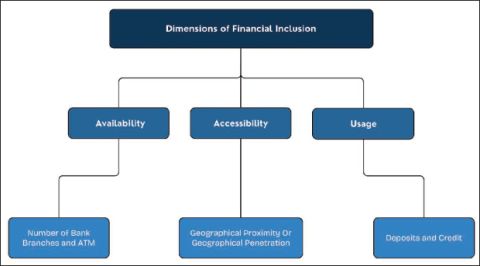
Financial inclusion has been broadly defined as the proportion of persons and enterprises making use of and benefiting from formal financial services (Demirguc-Kunt & Klapper, 2012; World Bank, 2014). Moving beyond just holding accounts, it embraces the provision of, ease of and utilisation of financial services (Arun & Kamath, 2015; Sahay et al., 2015). Foreseeing such a multidimensional nature, Sarma (2012) constructed a composite financial inclusion index (FII) covering these three pillars, which has been an immensely successful measure across cross-country research. Successive refinements, particularly those employing PCA, have enhanced the strength of such indices through data-based weights (Amidži.png) et al., 2014; Cámara & Tuesta, 2014; Chakravarty & Pal, 2013). Such methodological developments allow financial inclusion to also be measured across time as well as across countries, overcoming limitations of single-dimension proxies. Researchers also highlight interactions of financial inclusion with the institutional framework as well as with the economic development perspective. For instance, La Porta et al. (1999) demonstrated the impact of governance quality on the extent of financial access, while Levine (1997) highlighted financial development as a determinant of long-run growth. Research extending over regional-specific themes, such as Lenka and Bairwa (2016) on SAARC economies and Lenka and Barik (2018) on post-liberalised India, highlights how financial inclusion also determines the transmission of monetary value, rural–urban linkages, as well as equity in loan availing. As a whole, such research views financial inclusion as both an indicator of accessibility and an instrument of stability, growth and inclusive development, emphasising the importance of developing robust indices to measure it empirically. Figure 1 presents the dimensions of financial inclusion considered in the present study and their corresponding indicators.
et al., 2014; Cámara & Tuesta, 2014; Chakravarty & Pal, 2013). Such methodological developments allow financial inclusion to also be measured across time as well as across countries, overcoming limitations of single-dimension proxies. Researchers also highlight interactions of financial inclusion with the institutional framework as well as with the economic development perspective. For instance, La Porta et al. (1999) demonstrated the impact of governance quality on the extent of financial access, while Levine (1997) highlighted financial development as a determinant of long-run growth. Research extending over regional-specific themes, such as Lenka and Bairwa (2016) on SAARC economies and Lenka and Barik (2018) on post-liberalised India, highlights how financial inclusion also determines the transmission of monetary value, rural–urban linkages, as well as equity in loan availing. As a whole, such research views financial inclusion as both an indicator of accessibility and an instrument of stability, growth and inclusive development, emphasising the importance of developing robust indices to measure it empirically. Figure 1 presents the dimensions of financial inclusion considered in the present study and their corresponding indicators.
Concept of Institutional Quality
Institutions are the ‘rules of the game’ through which political, economic and social interactions are regulated (North, 1990). Institutional quality is an indicator of how well these rules are crafted and enforced to generate stability, equity and efficiency in government (North, 1990). Sound institutions enforce the rule of law, minimise corruption, protect property rights and generate stable policy regimes (Boukhatem & Moussa, 2023; Kaufmann et al., 2011). Inclusive institutions generate trust, minimise transaction costs, and increase access to markets and hence incentivise households and businesses to engage with the financial sector (Acemoglu et al., 2005). Extractive institutions, on the contrary, focus power and restrict opportunities, thereby undermining the efficiency and engagement of financial markets. Empirical evidence confirms that nations with greater institutional quality experience stronger growth, more equitable development and more developed financial markets (Chu et al., 2019; Eldomiaty et al., 2020; Saha & Dutta, 2022). Institutional quality, therefore, plays a crucial role in shaping financial behaviour and fostering confidence, extending beyond merely serving as a foundational conditioning factor. It determines how efficiently resources are mobilised, how innovative instruments like digital finance are embraced and how financial markets are resilient to shocks. For G20 nations that are leaders in global governance as well as financial innovation, the strength of institutions becomes an especially critical factor in maintaining inclusive financial ecosystems.
Figure 1. Dimensions of Financial Inclusion.
Nexus Between Institutional Quality and Financial Inclusion
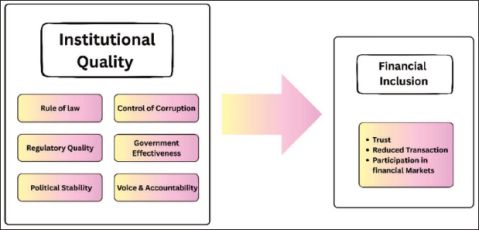
The finance and law scholarly community believes financial development is conditional upon the quality of the regulatory and legal infrastructure (Demirguc-Kunt & Maksimovic, 1998; La Porta et al., 1997, 1998). Neo-institutionalism (North, 1990) posits that high-quality institutions facilitate efficient resource allocation, foster innovations such as mobile banking and decrease transaction costs (Beck, 2016). Empirical work from Africa and Asia demonstrates that political stability, corruption containment and government effectiveness influence inclusion (Eldomiaty et al., 2020; Nkoa & Song, 2020; Nsiah & Tweneboah, 2023). However, there is a lack of G20-focused evidence despite their economic leadership worldwide. This leads to a geographic gap, a methodological gap (due to the lack of multidimensional measures) and a theoretical gap (resulting from insufficient institutional economic integration). Figure 2 depicts the conceptual linkage between institutional quality and financial inclusion that are explored in the present paper.
Research Methodology
Sample Selection and Data Source
The study employs a data set comprising 81 G20 nations, comprising 19 individual countries, the European Union and the African Union (as a permanent member since 2024) to analyse the relationship between institutional quality and financial inclusion. Annual data spanning 2014–2022 were sourced from the International Monetary Fund’s (IMF) Financial Access Survey (FAS) and the World Bank’s World Development Indicators (WDI), both of which are widely recognised for their reliability and cross-country comparability. Variable selection was informed by extensive empirical literature highlighting the role of financial inclusion in driving growth, stability and sustainable development. Key contributions include Omar and Inaba (2020) and Nsiah and Tweneboah (2023) on financial inclusion’s impact on poverty reduction and empowerment; Sharma (2016) linking inclusion and economic growth in India; Shaw’s (1973) theoretical work on financial deepening; and more recent studies by Stakic et al. (2021) and Tran et al. (2021) emphasising structural determinants and the role of institutional quality.
Figure 2. Linkages Between Institutional Quality and Financial Inclusion.
Furthermore, to capture structural heterogeneity within the G20, the study classifies countries into developed and emerging groups using the World Bank’s income classification, corroborated by the IMF’s World Economic Outlook. Developed economies represent high-income nations with mature institutions (e.g., the USA, Japan and Australia), while emerging economies include upper- and lower-middle-income countries undergoing rapid transformation (e.g., India, Brazil, Indonesia and South Africa). This classification ensures analytical consistency, reflects meaningful economic differences, and aligns with comparative literature on financial inclusion and institutional quality.
Rationale for the Study Period
The chosen time frame falls within a time of significant economic and institutional transitions. Following the financial crisis, world leaders, including those represented by the G20, placed a strong emphasis on increasing inclusiveness in the financial architecture as a means of enhancing greater resilience and stability (Aguera, 2015). The sharp decline in international oil prices during the same period also put more pressure on oil-exporting economies, making financial strength a more prominent aspect of the G20 agenda. Since 2014, there has been a rapid transformation in the digital technology arena, which involves reshaping financial structures with broader scopes of digital financial inclusion and more efficient service delivery (Alhassan et al., 2021). The COVID-19 pandemic (2019–2021) drew an intense spotlight on the health of digital platforms, highlighting them as a pivotal go-to channel for economic resilience and financial inclusion (GPFI, 2020). Moreover, geopolitical hotspots, including the 2022 Russia–Ukraine conflict, created greater uncertainty in all global markets, further highlighting the importance of strong institutions in maintaining financial stability. Lastly, empirical studies on emerging markets also reveal that structural determinants of financial inclusion (Stakic et al., 2021) as well as institutional quality strength (Tran et al., 2021) overwhelmingly determine the ability of economies to absorb shocks through inclusive growth. Generally, these processes render the aforementioned time frame an exemplary time interval to examine the institutional quality–financial inclusion nexus.
Variables Used in the Study
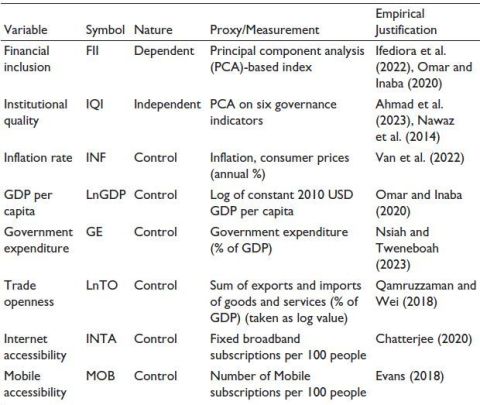
The present study classifies the variables as dependent, independent and control variables. The dependent variable is the FII, which has been constructed using the PCA technique to capture the multidimensional concept of financial inclusion. Table 1 summarises the variables (dependent, independent and control) considered in this paper including their measurement and empirical evidence related to the measurement. Similar to Sarma (2008), the index encompasses three primary components of financial inclusion: availability, accessibility and usage of financial services, thereby capturing a strong and comprehensive coverage (Omar & Inaba, 2020). The independent variable here is the institutional quality index (IQI), also constructed using PCA to minimise subjectivity in the weights. It covers six well-known Worldwide Governance Indicators, that is, rule of law, control of corruption, regulatory quality, government effectiveness, political stability, and voice and accountability. These indicators collectively reflect institutional and governing framework efficiency in shaping economic and financial outcomes (Kaufmann et al., 2011; Nawaz et al., 2014). Control variables were also considered to reflect potential macroeconomic determinants of financial inclusion. The considered variables are inflation, GDP per capita, government spending, trade openness, internet accessibility and mobile penetration. Their due importance has been reflected in earlier research, with research pointing out inflation to lessen real incomes (Ndoricimpa, 2017), GDP per capita increasing membership of the financial sector (Allen et al., 2014), government spending enhancing provision of infrastructural amenities and social spending (Ozili, 2018), trade openness enhancing economic growth and institutional development (Nsiah & Tweneboah, 2023; Qamruzzaman & Wei, 2018), and internet and mobile network access shaping digital financial inclusion (Chatterjee, 2020; Evans, 2018).
Table 1. Description of Variables.
Model Estimation
To examine the relationship between institutional quality and financial inclusion, the study employs a dynamic panel regression model. The baseline specification is formulated as follows:

where FII denotes the financial inclusion index, IQI represents the institutional quality index, and the remaining variables capture inflation (INF), GDP per capita (LnGDP), government expenditure (GE), trade openness (LnTO), internet accessibility (INTA) and mobile accessibility (MOB). The lagged dependent variable, FII is incorporated to capture the persistence of financial inclusion across time.
The estimation methodology applied is the system-generalised method of moments (system-GMM), which appropriately tackles endogeneity problems, heterogeneity and dynamic persistence in panel data specifications (Arellano & Bond, 1991). This choice of system-GMM is superior in data with a relatively large cross-section (nations) and short time dimension, as in this study. The application of PCA-based indices in both financial inclusion and institutional quality reduces subjectivity in weighting and ensures that the relative value of each dimension is determined from the data (Nawaz et al., 2014). The determination of the control variable draws from general institutional and development finance literature, highlighting institutional quality, macroeconomic stability and structural reform as critical determinants of financial inclusion (Arun & Kamath, 2015; Asian Development Bank [ADB], 2013). Furthermore, theoretical explanations, such as Banerjee and Newman’s (1993) focus on institutional arrangements influencing occupational choice and financial market participation, also vindicate institutional quality as the best explanatory variable. The Hausman test was applied to test the model specification, confirming the applicability of random effects in this case. Robustness was also established from diagnostic tests, comprising over-identifying restrictions tests (Sargan test) and tests against autocorrelation (Arellano–Bond AR(1) and AR(2) tests). These diagnostics collectively confirm the convergence and reliability of estimated coefficients (Kiviet & Kripfganz, 2021). Overall, this estimation framework provides an appropriate empirical formulation for capturing the influence of institutional quality on financial inclusion within the G20 landscape, considering both structural and macroeconomic determinants.
Results
Descriptive Statistics
Descriptive statistics of the variables are provided in Table 2. G20 economies exhibit a moderate level of financial inclusion, with an average FII value of 0.122 and a standard deviation of 0.608 during the study period. The IQI has an average value of 0.47, implying pronounced country heterogeneity in institutional quality. The average value of inflation is 7.26%, with a large standard deviation (28.63), signifying macroeconomic instability in several economies. Trade openness and government spending, however, tend to reveal stability, with coefficients of variation of 0.142 and 0.359, respectively. Mobile accessibility has an average value of 104.9 subscriptions per 100 people, with an average GDP per capita (log-transformed) of 8.67, implying a strong influence of digital penetration.
Multicollinearity Test (Variance Inflation Factor)
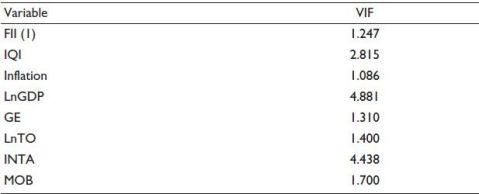
To render the estimated regression model dependable, the research applied the variance inflation factor (VIF) test to identify possible multicollinearity among the explanatory variables. As shown in Table 3, all VIF indices are well below the standard threshold. This result indicates that the independent and control variables used in the analysis do not pose serious multicollinearity problems, thereby making the estimated coefficients stable and interpretable.
Table 2. Descriptive Statistics.
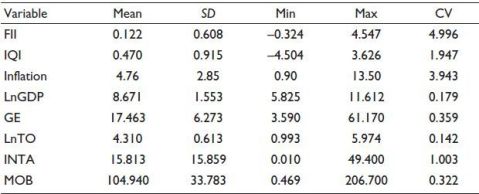
Table 3. Variance Inflation Factor (VIF) Test Results.
Unit Root Test
Before running regression analysis, it is essential to ensure that the variables under consideration are stationary, as non-stationary variables are prone to producing spurious results from regression analysis. For testing stationarity, the current study applied the Levin, Lin and Chu (LLC) panel unit-root test. All variables are statistically significant at 1% level, which suggests that H0 (panels contain unit roots) is rejected. This implies that all the variables are stationary and there is no long-run affiliation among the variables. Therefore, the possibility of spurious correlation in the model is cleansed, and the robustness of subsequent regression analysis is confirmed. Table 4 presents the result summary of Levin, Lin and Chu (LLC) Unit-root Test for checking the stationarity of the variables considered in the present paper.
Regression Analysis: Effect of Institutional Quality on Financial Inclusion
Table 5 shows the results of the dynamic panel regression model estimated using the system-GMM method. The diagnostic tests prove the robustness of the model, with the validity of instruments established from the Sargan test and the exclusion of serial correlation from the residuals from the Arellano–Bond AR(1) and AR(2) tests. The Wald χ2 statistic confirms the joint significance of the model, indicating strong overall explanatory power. With an R2 of 0.55, the model explains 55% of the variation in FII, reflecting a relatively high goodness of fit for panel data.
The lagged dependent variable FII (1) is positive and significant at high levels (β = 0.126, p < .01), highlighting the long-run persistence of financial inclusion over time. This means that households with more financial inclusion in the past periods tend to retain and expand inclusion in subsequent years. There is a positive and statistically significant effect (β = 0.035, p < .01) of the IQI, supporting the argument that better-informed structures of power, superior regulatory quality and reduced corruption contribute considerably to enhancing financial inclusion. Among the controls, LnGDP shows a substantial positive impact (β = 0.127, p < .01) on FII, indicating that as household income increases, individuals become financially empowered and thus motivated to join the formal financial system (Nsiah & Tweneboah, 2023). Trade openness has a positive influence (β = 0.065, p < .01), reflecting the value of international integration in enhancing both financial and institutional development. Mobile accessibility contributes marginally (β = 0.001, p < .05), indicating that mobile technologies play a significant role in addressing financial exclusion gaps. Meanwhile, inflation, government expenditure and internet accessibility reveal statistically insignificant contributions, suggesting that macroeconomic stability and internet penetration, in isolation, may not directly contribute to financial inclusion in the situation considered here.
Table 4. Levin, Lin and Chu (LLC) Unit-root Test Results.
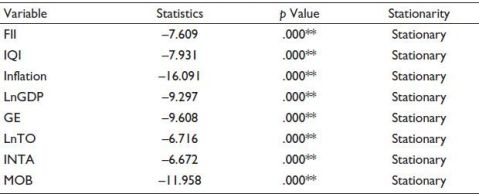
Note: ** indicates significance at the 1% level.
Table 5. Regression Results (System-generalised Method of Moments [System-GMM] Estimation).
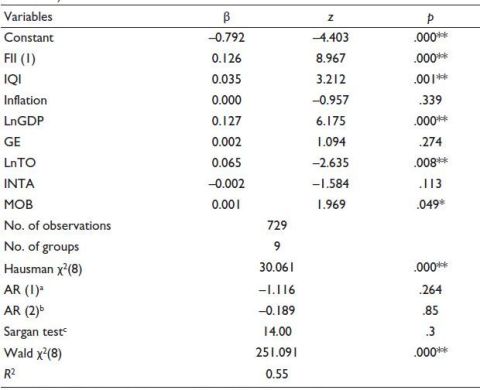
Notes: ** and * indicate significance at 1% and 5% levels, respectively.
aArellano–Bond first-order autocorrelation test (H0: no autocorrelation).
bArellano–Bond second-order autocorrelation test (H0: no autocorrelation).
cTest for over-identifying restrictions in GMM dynamic model estimation.
Table 6. Comparative Regression Summary: Developed Versus Emerging G20 Economies (System-generalised Method of Moments [System-GMM]).
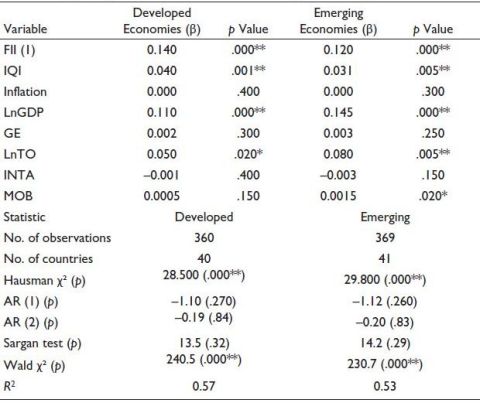
Notes: ** and * indicate significance at 1% and 5% levels, respectively.
ns = Not significant.
Coefficients are indicative based on subgroup analysis using system-GMM estimations.
Comparative Analysis: Developed Versus Emerging G20 Economies
The classification of G20 countries into developed and emerging groups is justified by the significant structural heterogeneity within the bloc. While developed economies, such as the USA, Japan and the European Union, exhibit mature institutional frameworks, advanced financial systems and widespread digital infrastructure, emerging economies, such as India, Brazil and South Africa, face governance gaps, infrastructural constraints and uneven technological diffusion, but often experience rapid growth. A pooled analysis would mask these differences; therefore, a comparative approach allows the study to capture heterogeneous effects, examine differential institutional impacts and derive context-specific policy insights. This rationale is grounded in institutional and financial development theories (North, 1990; Shaw, 1973). To deepen the empirical insights, the study distinguishes between developed and emerging G20 economies, acknowledging that differences in institutional frameworks, technological readiness and economic structures shape financial inclusion dynamics. The developed group comprises 40 economies, including the USA, the European Union, Japan and Australia, while the emerging group includes 41 countries, such as India, Brazil, South Africa and Indonesia. Separate system-GMM regressions were estimated for each subgroup, and the results are summarised in Table 6 with coefficient estimates and p values. Key differences emerge across groups. Institutional quality (IQI) has a positive and significant effect in both developed (β = 0.040, p = .001) and emerging economies (β = 0.031, p = .005), although the impact is slightly stronger in developed economies due to their mature governance structures. Economic growth (LnGDP) is a major driver in both groups but is more pronounced in emerging economies (β = 0.145, p = .000), reflecting catch-up dynamics. Trade openness (LnTO) and mobile penetration (MOB) show stronger effects in emerging economies, highlighting the role of global integration and digital leapfrogging in expanding access. In developed economies, mobile penetration is insignificant (p = .150), likely due to market saturation. Inflation, government expenditure and internet access remain insignificant in both groups, consistent with the main regression results.
Discussion
The findings of this study reinforce the critical influence of institutional quality in enhancing financial inclusion, which is entirely consistent with the institutional economic foundations. North (1990) proposed institutions as the ‘rules of the game’ shaping economic interactions through minimising uncertainty and transaction costs, while Acemoglu et al. (2005) argued that incumbent institutions fostered trust, innovation and broad-based market participation. The empirical support verifies these theoretical explanations, providing evidence that strong institutional frameworks operationalised through efficient governance, quality of regulation, political stability and observance of the rule of law positively influence financial inclusion across the G20 countries. This finding is also consistent with the work of Nsiah and Tweneboah (2023), who argued that good governance quality builds trust and encourages households to participate in the formal financial sector.
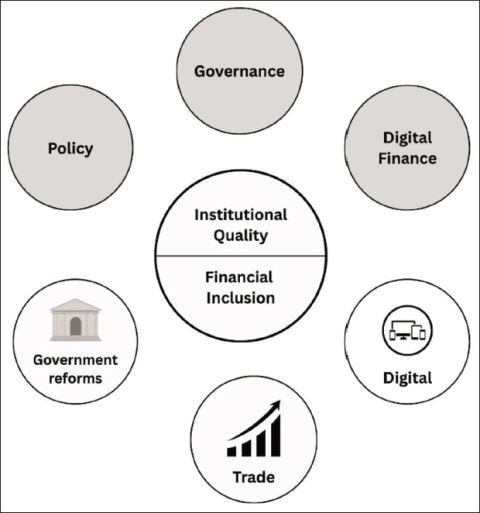
A comparison of developed and emerging G20 markets provides additional contextual insight into these interactions. For developed markets, financial inclusion is already sufficiently high, and the primary roles of institutional quality continue to include securing economic efficiency, facilitating regulatory development and promoting technological innovation (Zhou et al., 2023). For emerging G20 markets, institutional quality plays a more fundamental role in bridging governance gaps, reducing corruption and fostering public trust in the formal financial sector (Hassan et al., 2019). The substantial impact of GDP per capita and mobile penetration across the developed and emerging economies indicates that institutional reforms, in conjunction with economic growth and the adoption of digital technologies, create significant synergies with financial inclusion (Chatterjee, 2020). In contrast, the persistent lack of significance of inflation, government expenditure and internet penetration suggests that macroeconomic stability and infrastructural provision are insufficient without the support of institutional strength. Figure 3 demonstrates the conceptual framework linking institutional quality and financial inclusion with policy, governance, digital finance, trade and reforms analysed in the present paper.
Figure 3. Conceptual Framework Linking Institutional Quality and Financial Inclusion with Policy, Governance, Digital Finance, Trade and Reforms.
Conclusion and Policy Implications
This study investigated the correlation of institutional quality with financial inclusion across G20 countries (and the African Union) during the 2014–2022 period with the help of financial inclusion (FII) and institutional quality (IQI) composite indices prepared via the PCA method. By combining indicators of availability, accessibility and usage of financial services with six governance indicators, the research offers a multidimensional and technically adequate assessment of financial inclusion. The utilisation of dynamic panel regression techniques (system-GMM) also strengthens the empirical adequacy of the findings by correcting endogeneity and persistence issues.
The results provide strong evidence supporting the argument that institutional quality makes a positive and significant contribution to financial inclusion. Sound frameworks of governance, particularly effective regulation, low corruption and sound accountability, significantly enhance access to financial services and elicit public trust in the financial sector. Furthermore, the analysis also reveals economic growth (GDP per capita), trade openness and mobile penetration as further determinants in support of financial inclusion, while inflation, government expenditure and internet penetration do not play a statistically significant role in the equation. There is a unique contribution to the research through the introduction of institutional strength as the fulcrum in the determination of inclusive financial systems across a heterogeneous pool of advanced and emerging markets and developing economies.
From a policy perspective, there are a number of takeaways. First, institutional strengthening, predominantly through governance reform with an emphasis on corruption management, regulatory implementation and political stability, is essential for advancing financial inclusion. Second, given the significant role of mobile accessibility, digital finance holds substantial potential for enhancing financial inclusion through mobile money platforms. It is imperative to promote fintech innovation while ensuring consumer protection and maintaining systemic stability. Third, institutional quality is both an agent of change and a stabiliser. Developed markets should prioritise the maintenance of institutional strength, while emerging markets should simultaneously seek to strengthen their governance and utilise digital innovations to address frequent gaps in financial access. Fourthly, the government and other regulatory authorities should formulate policies that ensure financial stability in the financial sector. Ultimately, international cooperation among G20 countries facilitates the achievement of a more inclusive global financial system.
The study has acknowledged a few limitations. First, it has selected the sample from the G20 countries. It has not considered other countries from different regions, for which the problem of generalising findings is likely to arise. Second, due to the unavailability of data on specific indicators of financial inclusion, the present study confined its findings to limited indicators, such as the number of commercial bank branches per 100,000 adults, the number of ATMs per 100,000 adults and the number of commercial bank branches per 1,000 square kilometres, among others. Third, due to parsimony and time constraints, the present study has confined its data set to a 9-year timeline, and predetermined variables have only been used. Finally, the applied econometric tool has inherent limitations that may also impact the results.
It has also sketched a roadmap for future studies. Initially, as the study has incorporated only 81 sample countries from G20 members, future research may be conducted by incorporating more samples to gain better insights into this critical relationship. Second, the excluded variables, such as ICT indicators, research and development expenditure, digital currencies, gross capital formation and money supply, may be incorporated in posterior studies to obtain more categorical results on each variable. Third, future researchers can use different indicators to measure financial inclusion and, thus, incorporate innovative findings. Finally, future researchers can investigate the influence of institutional quality on financial inclusion in other emerging economies, including low-income countries, to compare and enrich the current study’s findings.
Declaration of Conflicting Interests
The authors declared no potential conflicts of interest with respect to the research, authorship and/or publication of this article.
Funding
The authors received no financial support for the research, authorship and/or publication of this article.
ORCID iD
Pranesh Debnath https://orcid.org/0000-0003-3423-6081
Acemoglu, D., Johnson, S., & Robinson, J. A. (2005). Institutions as a fundamental cause of long-run growth. Handbook of Economic Growth, 1, 385–472. https://doi.org/10.1016/S1574-0684(05)01006-3
Aguera, P. (2015). Financial inclusion, growth and poverty reduction. ECCAS Regional Conference, Brazzaville, Congo, World Bank Group.
Ahmad, M., Kuldasheva, Z., Nasriddinov, F., Balbaa, M. E., & Fahlevi, M. (2023). Is achieving environmental sustainability dependent on information communication technology and globalization? Evidence from selected OECD countries. Environmental Technology & Innovation, 31, 103178. https://doi.org/10.1016/j.eti.2023.103178
Ajide, K. B., Raheem, I. D., Alimia, O. Y., & Asongu, S. A. (2020). The role of institutional infrastructures in financial inclusion–growth relations: Evidence from SSA. International Journal of Finance & Economics, 27, 175–191. https://doi.org/10.1002/ijfe.2145
Alhassan, A., Li, L., Reddy, K., & Duppati, G. (2021). The relationship between political instability and financial inclusion: Evidence from Middle East and North Africa. International Journal of Finance & Economics, 26(1), 353–371. http://dx.doi.org/10.1002/ijfe.1793
Allen, F., Carletti, E., Cull, R., Qian, J. Q., Senbet, L., & Valenzuela, P. (2014). The African financial development and financial inclusion gaps. Journal of African Economies, 23(5), 614–642. https://doi.org/10.1093/jae/eju015
Amidži, G., Massara, A., & Mialou, A. (2014). Assessing countries’ financial inclusion standing: A new composite index (IMF Working Paper 14/36). International Monetary Fund. https://www.imf.org/external/pubs/ft/wp/2014/wp1436.pdf
Arellano, M., & Bond, S. (1991). Some tests of specification for panel data: Monte Carlo evidence and an application to employment equations. The Review of Economic Studies, 58(2), 277–297.
Arun, T., & Kamath, R. (2015). Financial inclusion: Policies and practices. IIMB Management Review, 27(4), 267–287. https://doi.org/10.1016/j.iimb.2015.09.004
Asian Development Bank (ADB). (2013). Supporting good governance: A thematic evaluation study of ADB. https://www.adb.org/sites/default/files/evaluation-document
Banerjee, A. V., & Newman, A. F. (1993). Occupational choice and the process of development. Journal of Political Economy, 101(2), 274–298. http://www.jstor.org/stable/2138820
Beck, T. (2016). Financial inclusion—Measuring progress and progress in measuring. In The Fourth IMF Statistical Forum: Lifting the small boats: Statistics for inclusive growth. Cass Business School, City, University of London, CEPR, and CESifo. https://www.imf.org/external/np/seminars/eng/2016/statsforum/pdf/beck_paper.pdf
Bernabe, M. D. (2017). Redefining inclusive growth in Asia (Briefing Paper). Oxfam International. https://www.oxfam.org/en/research/redefining-inclusive-growth-asia
Boukhatem, J., & Moussa, F. B. (2023). Financial inclusion, institutional quality, and economic growth in MENA countries: Some evidence from panel cointegration. Macroeconomics and Finance in Emerging Market Economies, 18(2), 319–342. https://doi.org/10.1080/17520843.2023.2284455
Cámara, N., & Tuesta, D. (2014). Measuring financial inclusion: A multidimensional index (BBVA Research Working Paper 14/26). https://www.bbvaresear
Chakravarty, S. R., & Pal, R. (2013). Financial inclusion in India: An axiomatic approach. Journal of Policy Modeling, 35(5), 813–837. https://doi.org/10.1016/j.jpolmod.2012.12.007
Chatterjee, A. (2020). Financial inclusion, information and communication technology diffusion, and economic growth: A panel data analysis. Information Technology for Development, 26(3), 607–635. https://doi.org/10.1080/02681102.2020.1734770
Chu, L. K., Minh, P. N., & Huong, T. H. D. (2019). Determinants of financial inclusion: New evidence from panel data analysis. SSRN Electronic Journal. https://ssrn.com/abstract
Cull, R., Demirgüç-Kunt, A., & Lyman, T. (2012). Financial inclusion and stability: What does research show? World Bank Group. https://documents.worldbank.org/
Demirguc-Kunt, A., & Klapper, L. (2012). Measuring financial inclusion: The Global Findex Database (Policy Research Working Paper No. 6025). World Bank. https://elibrary.worldbank.org/doi/abs/10.1596/1813-9450-6025
Demirguc-Kunt, A., & Maksimovic, V. (1998). Law, finance and firm growth. Journal of Finance, 53(6), 2107–2137. https://doi.org/10.2139/ssrn.139825
Eldomiaty, T., Hammam, R., & El Bakry, R. (2020). Institutional determinants of financial inclusion: Evidence from world economies. International Journal of Development Issues, 19(2), 217–228. https://doi.org/10.1108/IJDI-08-2019-0147
Evans, O. (2018). Connecting the poor: The internet, mobile phones and financial inclusion in Africa. Digital Policy, Regulation and Governance, 20(6), 568–581. http://dx.doi.org/10.1108/DPRG-04-2018-0018
Fakher, H. A., Panahi, M., Emami, K., Peykarjou, K., & Zeraatkish, S. Y. (2021). New insight into examining the role of financial development in economic growth effect on a composite environmental quality index. Environmental Science and Pollution Research, 28(43), 61096–61114. https://doi.org/10.1007/s11356-021-15047-2
Global Partnership for Financial Inclusion (GPFI). (2020). About GPFI. https://www.gpfi.org/about-gpfi
Hassan, A. S., Kot, S., & Meyer, D. F. (2019). Effect of institutional quality and wealth from oil revenue on economic growth in oil-exporting developing countries. Sustainability, 11(13), 3635. https://doi.org/10.3390/su11133635
Ifediora, C., Offor, K. O., Eze, E. F., Takon, S. M., Ageme, A. E., Ibe, G. I., & Onwumere, J. U. (2022). Financial inclusion and its impact on economic growth: Empirical evidence from sub-Saharan Africa. Cogent Economics & Finance, 10(1), 2060551.
Inoue, T. (2019). Financial inclusion and poverty reduction in India. Journal of Financial Economic Policy, 11(1), 21–33. http://dx.doi.org/10.1108/JFEP-01-2018-0012
Kaufmann, D., Kraay, A., & Mastruzzi, M. (2011). The Worldwide Governance Indicators: Methodology and analytical issues. Hague Journal on the Rule of Law, 3(2), 220–246. https://doi.org/10.1017/S1876404511200046
Kiviet, J. F., & Kripfganz, S. (2021). Instrument approval by the Sargan test and its consequences for coefficient estimation. Economics Letters, 205, 109935.
La Porta, R., Lopez-de-Silanes, F., Shleifer, A., & Vishny, R. (1997). Legal determinants of external finance. Journal of Finance, 52(3), 1131–1150. http://dx.doi.org/10.1111/j.1540-6261.1997.tb02727.x
La Porta, R., Lopez-de-Silanes, F., Shleifer, A., & Vishny, R. (1998). Law and finance. Journal of Political Economy, 106(6), 1113–1155. https://doi.org/10.1086/250042
La Porta, R., Lopez-de-Silanes, F., Shleifer, A., & Vishny, R. (1999). The quality of government. Journal of Law, Economics, and Organization, 15(1), 222–279. https://scholar.harvard.e.pdf
Lenka, S. K., & Bairwa, A. K. (2016). Does financial inclusion affect monetary policy in SAARC countries? Cogent Economics & Finance, 4(1). https://doi.org/10.1080/23322039.2015.1127011
Lenka, S. K., & Barik, R. (2018). A discourse analysis of financial inclusion: Post liberalization mapping in rural and urban India. Journal of Financial Economic Policy, 10(2), 210–226. https://doi.org/10.1108/JFEP-11-2015-0065
Levine, R. (1997). Financial development and economic growth: Views and agenda. Journal of Economic Literature, 35(2), 688–726. http://www.jstor.org/stable/2729790
Mani, M. (2016). Financial inclusion in South Asia—Relative standing, challenges and initiatives. South Asian Survey, 23(2), 158–179. http://dx.doi.org/10.1177/0971523118783353
Nawaz, S., Iqbal, N., & Khan, M. A. (2014). The impact of institutional quality on economic growth: Panel evidence. The Pakistan Development Review, 53(1), 15–31. http://dx.doi.org/10.30541/v53i1pp.15-31
Ndoricimpa, A. (2017). Threshold effects of inflation on economic growth in Africa: Evidence from a dynamic panel threshold regression approach (Working Paper Series No. 249). African Development Bank. https://www.afdb.org/sites/default/files/documents/publications
Nguyen, T. T. H. (2020). Measuring financial inclusion: A composite FI index for the developing countries. Journal of Economics and Development, 23(1), 77–99. https://doi.org/10.1108/JED-03-2020-0027
Nkoa, B. E. O., & Song, J. S. (2020). Does institutional quality affect financial inclusion in Africa? A panel data analysis. Economic Systems, 44(4), 100836. https://doi.org/10.1016/j.ecosys.2020.100836
North, D. C. (1990). Institutions, institutional change and economic performance. Cambridge University Press. https://doi.org/10.1017/CBO9780511808678
Nsiah, A. Y., & Tweneboah, G. (2023). Determinants of financial inclusion in Africa: Is institutional quality relevant? Cogent Social Sciences, 9(1). https://doi.org/10.1080/23311886.2023.2184305
Omar, M. A., & Inaba, K. (2020). Does financial inclusion reduce poverty and income inequalities in developing countries? A panel data analysis. Economic Structures, 9, 37. https://doi.org/10.1186/s40008-020-00214-4
Ozili, P. K. (2018). Impact of digital finance on financial inclusion and stability. Borsa Istanbul Review, 18(4), 329–340. https://doi.org/10.1016/j.bir.2017.12.003
Qamruzzaman, M., & Wei, J. (2018). Financial innovation, stock market development, and economic growth: An application of ARDL model. International Journal of Financial Studies, 6(3), 69.
Saha, M., & Dutta, K. D. (2022). Does governance quality matter in the nexus of inclusive finance and stability? China Finance Review International, 13(1), 121–139. https://doi.org/10.1108/CFRI-08-2021-0166
Sahay, R., Cihak, M., N’Diaye, P. M., Barajas, A., Mitra, S., Kyobe, A., Mooi, Y. N., & Yousefi, S. R. (2015). Financial inclusion: Can it meet multiple macroeconomic goals? (IMF Staff Discussion Note 15/17). International Monetary Fund. https://www.imf.org/external/pubs/ft/sdn/2015/sdn1517.pdf
Sarma, M. (2008). Index of financial inclusion (ICRIER Working Paper No. 215). Indian Council for Research on International Economic Relations. https://www.icrier.org/pdf/Working_Paper_215.pdf
Sarma, M. (2012). Index of financial inclusion: A measure of financial sector inclusiveness (Working Paper). Jawaharlal Nehru University. https://Finance_Trade_Development/working_paper_series/wp_07_2012_Sarma_Index-of-Financial-Inclusion.pdf
Sharma, D. (2016). Nexus between financial inclusion and economic growth: Evidence from the emerging Indian economy. Journal of Financial Economic Policy, 8(1), 13–36. https://doi.org/10.1108/JFEP-01-2015-0004
Shaw, E. S. (1973). Financial deepening in economic development. Oxford University Press.
Stakic, N., Barjaktarivic, L., & Singh, D. (2021). Key determinants of financial inclusion: Empirical evidence from Western Balkan countries. In Financial inclusion in emerging markets (pp. 49–69). Springer. https://doi.org/10.1007/978-981-16-2652-4-3
Tran, O. K. T., Le, H. D., & Nguyen, A. H. V. (2021). Role of institutional quality in economic development: A case study of ASEAN countries. Problems and Perspectives in Management, 19(2), 303–312. http://dx.doi.org/10.21511/ppm.19(2).2021.29
United Nations Development Programme. (2015). Governance for sustainable human development.
Van, L. T., Nguyen, N. T., Nguyen, H. L., & Vo, D. H. (2022). The asymmetric effects of institutional quality on financial inclusion in the Asia-Pacific region. Heliyon, 8(12), e12016. https://doi.org/10.1016/j.heliyon.2022.e12016
Verhoef, G. Hidden. (2022). Savings groups in South Africa. In Transforming Africa. Emerald.
World Bank. (2014). Global financial development report 2014: Financial inclusion.
Zadek, S., & Robins, N. (2018). Making waves: Aligning the financial system with sustainable development. United Nations Environment Programme. https://www.unepfi.org/publications/
Zhou, P., Su, M., & Zheng, Y. (2023). Economics of institutional quality in the nexus of innovation, technology, and financial market development: International evidence. Applied Economics Letters, 32(5), 715–720. https://doi.org/10.1080/13504851.2023.2288033
